I’m sure this first line of this blog will have turned some people away (my partner among them). It is a tough topic, particularly in Western culture, where many of us have never witnessed the moment of death or handled a dead body.
While studies suggest that de-tabooifying death is actually conducive to joy and inner peace, how we handle conversations about death varies a great deal across cultures and individual attitudes. It ranges from “we don’t talk about that” (said while blushing) to meditating about it five times a day, as the Bhutanese do, for example.
My own attitude towards death has changed considerably over the years. I grew up an observant Catholic, with an almost-Dantesque vision of the afterlife. I then moved to a decisively secular, agnostic approach and, for many years, I thought that would be it: my view about death had reached the opposite end of the spectrum, from religion to atheism, and there was nothing else left to explore at that end of the spectrum.
I was wrong.
Sometime ago, during a conversation with my partner, who happens to be profoundly troubled by the uncertainty of the afterlife, I said:
If you have problems with death, perhaps you should question your mental map about life.
And that is a switch of perspective that I recommend to anyone who is hungry for further investigation but is feeling somewhat stuck. I went through it as well and I more recently adopted a new mental map about life, with a consequent major impact on my view about death, that is serving me incredibly well, particularly in this time of COVID.
Since the pandemic has led many of us to contemplate the thought of our own death, I’d like to share my mental map about life (and death) in case it can serve anyone else or even just prompt some new thinking.
Photo by Karl Magnuson on Unsplash
A human label
I think life (and therefore death) is a human label. Apart from any religious views, if we want to define life we only have a list of clumsy requirements that something needs to meet to be called alive. I say "clumsy" because it's actually a complicated list, it's about chemical and biological processes, and there's no unanimous consensus about it. Shouldn't "life" be something much simpler to define?
From the point of view of the continuous evolution of the universe, there's no difference between the evolution of a rock and that of a human being. Both obey the same laws of physics. Both undergo the transformation on which path the universe has put them. Parts of a rock have been or will be parts of a human being one day. Parts of a human being have been or will be parts of a rock one day. What we call a rock is a rock today; it was something very different before and it'll be something very different one day. The timescale of a rock's transformation is very dissimilar to that of a human being, obviously, but does timescale make us so different then?
So, in my mental map, life is everything.
Everything is alive.
Including insentient things like a rock. And nothing is dead.
This doesn't make the loss of a dear one less painful. Not at all. But if I think of my own death, if I think of my own life, I feel like I'm just a little piece of the universe going through this particular phase of its continuous evolution. This is my current state. I was something else before, and I'll be something else after, just as a banana became part of my body yesterday and an avocado will tomorrow.
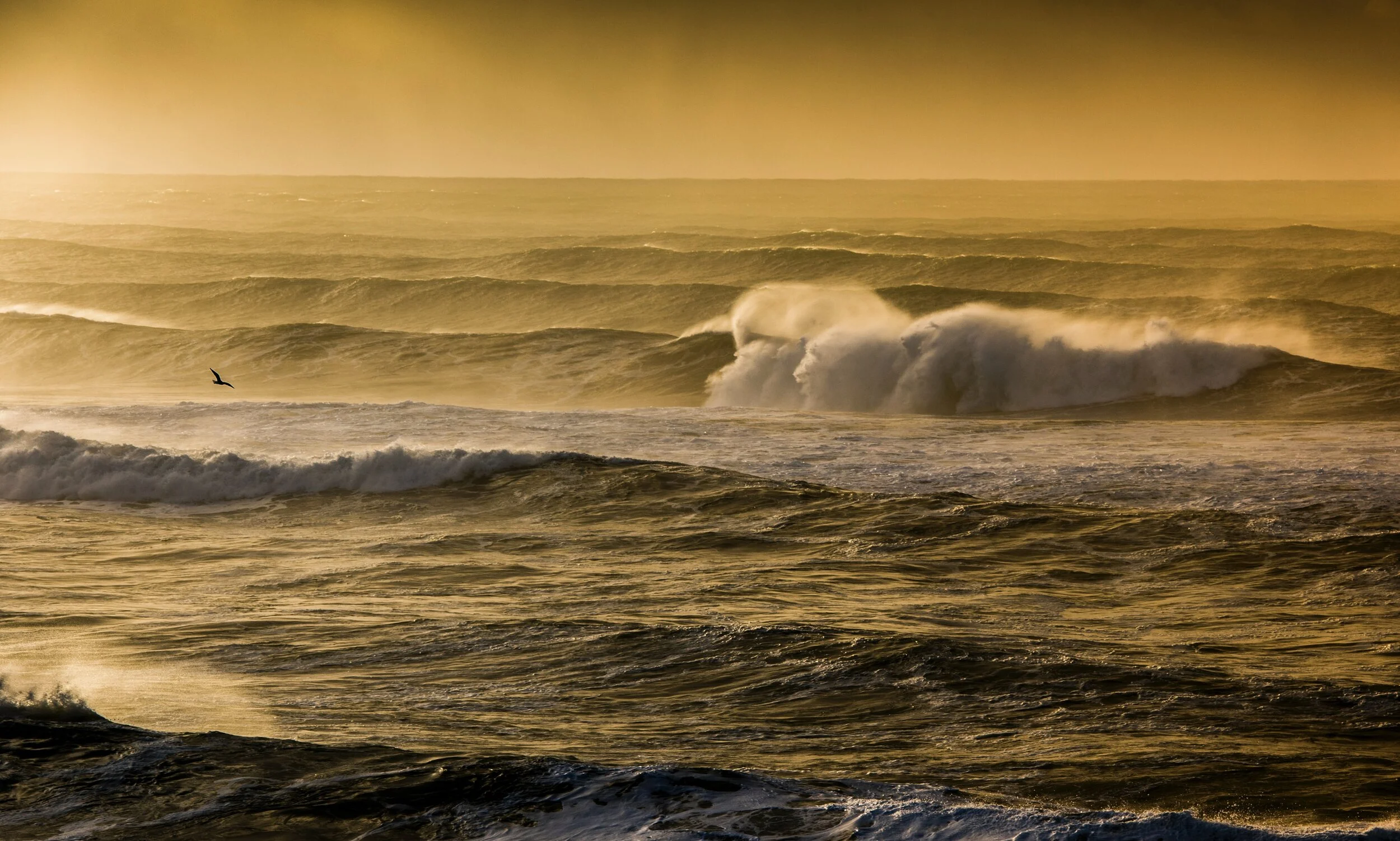
There's a famous story that I heard from a Buddhist monk. I'm sure some of you know it too, it's about the ocean and the waves.
Photo by Payton Bissell on Unsplash
Like waves in the ocean
Our lives are like the waves of the ocean. All of a sudden, a wave is formed. It wasn't there a minute ago and all of a sudden, there you go, you know that you're looking at a wave. You can clearly see its outline and boundaries. How magical is that?, Well, it’s not magical at all, but it’s very beautiful.
The flat ocean has now produced a wave! And the wave travels its own journey towards the shore. And in every moment of that journey, you can still recognise it: that's the wave you just saw take form out of the flat ocean. So, that wave now has an identity. And so do we. I can clearly recognise my own outline and boundaries, but if I identify myself with that outline and those boundaries, if I identify myself with the wave, I'll call my crashing against the shore death. However, if I identify myself with the ocean, there's no death, just transformation, evolution, surely more radical than eating an avocado instead of a banana, but not different in its nature.
The ocean has been there all the time. The wave was just a stage of its continuous evolution.
I once heard the story of a famous swami who was about to die when one of his disciples told him: "Please, swamiji, don't leave us." To which the swami replied: "And where would I go?"
*****
Like I was mentioning above, the loss of a dear one is a completely different story. The compassion for their pain and the grieving for our loss are absolutely real, whether I identify myself with the ocean or the wave.
But when I think of my own life and death, it gives me a lot of peace to know that this human experience that I’m in right now is actually just the universe going through a phase.
I am a phase of the universe.
I hope this can be a source of peace for many of you, too.
*****
Further reflections
At Wise Humanity, we normally include an exercise in all our blog posts, so that you can turn the concepts into an everyday practice in your life.
Today, what I’d like to recommend is that you carve out a few minutes, take a pause, sit comfortably in a quiet place, close your eyes and reflect on what it would mean for you if you started thinking that everything around you is alive, both sentient beings and insentient things; that everything is part of a big ocean that is travelling through space-time and, while on that journey, is evolving and developing.
Why do obvious team problems go unaddressed? The usual fixes, from pulse surveys to away days and perks, soothe the symptoms without touching the cause. So what stops everybody from going beyond the surface?
I've just started a round of interviews to solve this mystery. If you're a team leader, senior manager, or executive and you'd like to be interviewed, send me a message. I'll share the outcome of the study with everyone who takes part.
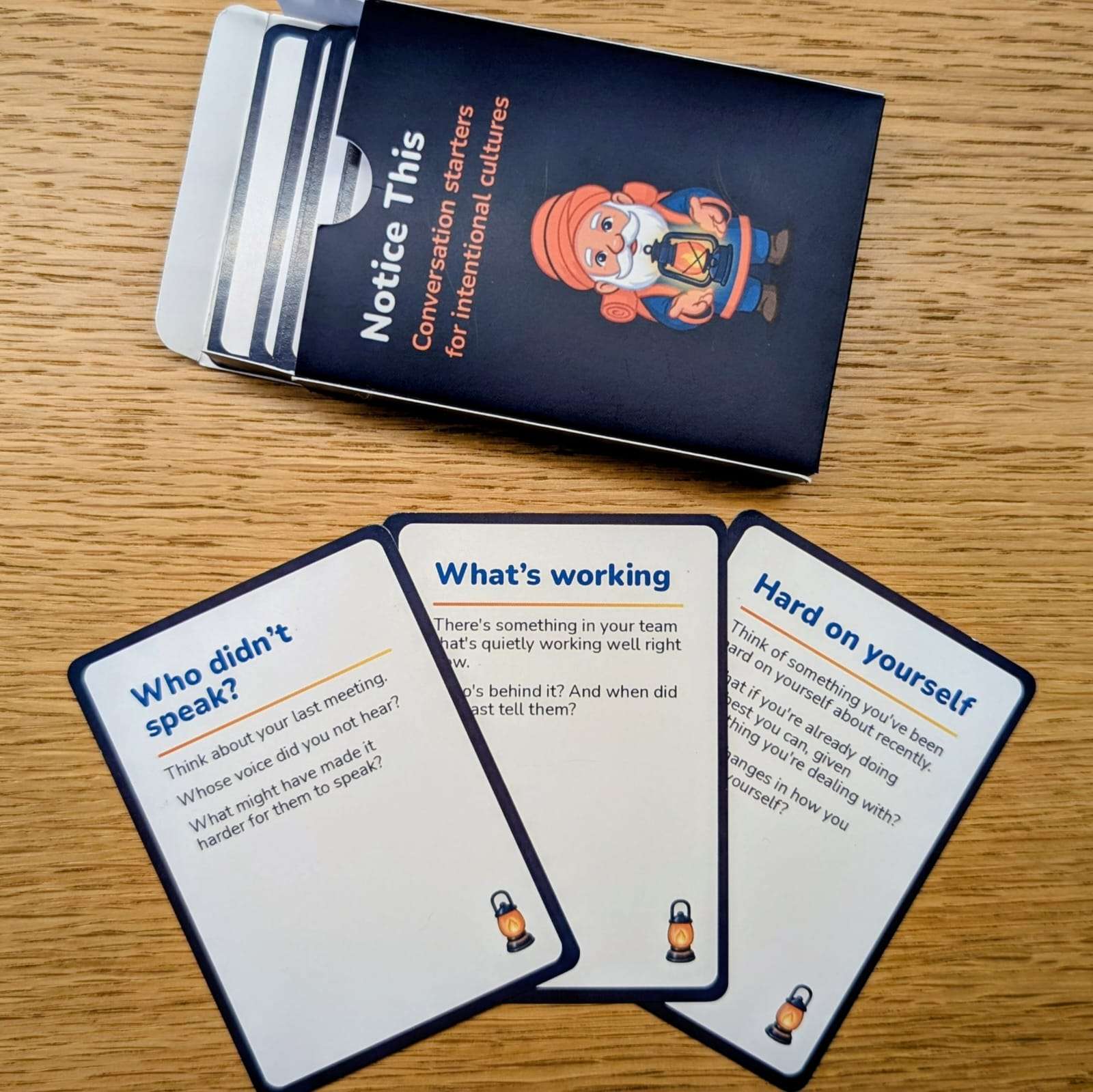
A few weeks ago, we launched our Hu.Be platform at the Engage Employee Summit in London. And to engage with people, we created this “conversation starters” card deck.