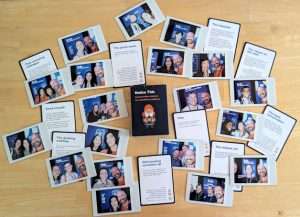
We’d ask them to pick a card; they’d read it and, within a minute, we’d be talking about something real... for themselves, their teams or the people around them: the thing they'd been meaning to say for weeks, the resignation nobody saw coming, a particularly difficult colleague.
So let me ask you the same thing. Here are three cards. Pick one.
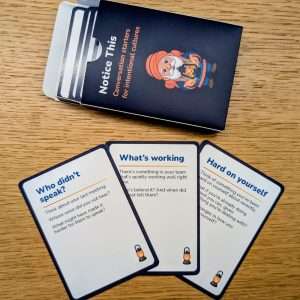
Card one. Who didn't speak?
Think about your last meeting. Whose voice did you not hear?
In most meetings, someone says less than they could. It's easy to read that silence as agreement, or as having nothing to add. Usually it's neither.
Silence is shaped by the room. By who gets interrupted, whose ideas get built on, who felt the cost last time they spoke up.
I remember when, fresh from Uni, I wouldn’t speak at meetings because I wasn’t absolutely sure I had “the right” answer.
The voices you didn't hear might have been the ones you needed most. Worth asking, before the ****next meeting, what would make it easier for them to speak.
Card two. What's working
There's something in your team that's quietly working well right now. Who's behind it? And when did you last tell them?
We're quick to spot what's broken. We're trained for it. What works tends to pass unnoticed, precisely because it works.
But the things that go well have people behind them. A quiet effort, a habit someone keeps, a standard somebody holds. When that goes unnamed, the person stops being sure it matters, and nobody else learns how it's done.
You might have a similar upbringing to mine; my parents would never congratulate me on a good mark at school. It was just my job, they said.
Noticing what works isn't soft. It's how good things last. So this week, find the thing that's working, and tell the person behind it.
Card three. Hard on yourself
Think of something you've been hard on yourself about recently.
We pardon things in others; we rarely do it in ourselves. When a colleague struggles, we think about their workload, their week, everything they're carrying. When we struggle, we just think we’re not good enough.
The same logic applies to you. You're working with the conditions you're in, and the experiences that shaped you. You're probably doing the best you can with both.
The voice in your head could afford to be as fair as the one you use with everyone else.
These are three of 38 cards. We made them as conversation starters, and we gave them away at the conference where we launched Hu.Be.
The cards are Hu.Be in physical form. One card, one situation, one conversation, one change. Hu.Be does the same, without you or your team having to pick a card. It's free to try for individuals. There's a private space just for you, and a space to bring any real situation and get insights and practical guidance back.
Where it goes further is with a whole team. Your company already has a culture. Hu.Be is about making it the one you want: he learns how your team actually works, suggests small changes grounded in your values, and shows you whether your culture is shifting.
We're looking for companies to partner up and run pilots with. If you'd like to explore this, book a call with me.
And if you'd simply like the cards, we’d love to send you a deck at cost (£10 + postage). We're not giving them away because something free tends to sit in a drawer, and these are made to be used. Order here.
Pick a card. See where the conversation goes.
Big hug,
Davide and the Wise Humanity Team