
How do you show care without sounding manipulative?
I was running a workshop the other day when someone asked me a question that hit me deep:

Davide Pagnotta · 13 July 2026 · 4 min read

Why do obvious team problems go unaddressed? The usual fixes, from pulse surveys to away days and perks, soothe the symptoms without touching the cause. So what stops everybody from going beyond the surface? I've just started a round of interviews to solve this mystery. If you're a team leader, senior manager, or executive and you'd like to be interviewed, send me a message. I'll share the outcome of the study with everyone who takes part.
Davide Pagnotta · 30 September 2026 · 4 min read
Your team has some problems. You know it. They know it. And the away day isn't going to fix them.
Everyone can see the culture isn't great. It's not bringing out the best in anyone. Everyone can see it's hurting the business. Still, the same pulse survey keeps going out again and again.

I've just started a round of interviews with team leaders, senior managers, and executives. I'm asking two simple questions from lots of different angles: what triggers the decision to actually do something about a team problem? And what prevents it?
I'm right in the middle of it, with no conclusions yet. But one pattern keeps coming up, and it's alarming.
Everyone seems to be aware of the problems. Disengagement. Lack of accountability. Loss of confidence. Ego clashes. Poor psychological safety.
Everyone can see the impact too. Teams miss deadlines, delay decisions, innovate too slowly, and lose clients.
And yet, there’s an elephant in the room, and something stops anyone from going beyond the surface.
It's not that nothing is being done. Surveys, team building, and perks all help a little. But they soothe the symptoms without solving the cause. The survey measures the disengagement. The away day gives everyone a good afternoon. The perk makes our personal lives a bit nicer, but the same problems await us at the office.
At the last corporate I worked for, the culture was so bad that raising a problem made you look incompetent. So nobody raised them. Not in meetings, not in surveys, not at team-building days.
Until one of those unspoken problems bankrupted the company, and 1,000 out of 6,000 people lost their jobs.
Everybody knew we had a culture problem. Nobody acted.
I don't tell this story to point fingers. The people in that company weren't careless, and they weren't bad managers. Most of them cared a great deal. They were doing the best they could in conditions that made silence feel like the only sensible option, and fixing problems on your own look like the only acceptable way to manage.
That's exactly what makes it worth understanding. It was a culture problem, not one you could solve by hiring different people.
When people explain why a problem stays unraised, the same sentences come up again and again:
"If I raise it, I'm the problem."
"Leadership doesn't want to hear it."
"Nothing will change anyway."
"I'll be marked as not being a team player."
"I don't trust that it's safe."
And often, these sentences come from the actual leaders.
None of these are about not seeing the problem. They're about what it feels like to name it and look for a real solution.

So what is it? What turns awareness into action, and what actually blocks it? Why do we turn a blind eye?
A couple of threads already seem to be surfacing.
One is not knowing which problem is the real one. Disengagement is visible. But is it the cause, or a symptom of something underneath: unclear roles, lost trust, a change nobody explained? When the real problem isn't clear, any action feels like a guess, and guessing feels risky. So waiting for things to sort themselves out can feel like the responsible choice.
Another is a quiet belief that nothing will change anyway. Not loud cynicism. Just a tiredness that comes from having seen the survey, the away day, and the perk before.
Are these the real blockers? Are there others hiding behind them? I don't know yet. That's the point of the study.
Would you like to be interviewed?
While the interviews continue, here are four questions any of us can bring to our own teams this week:
What does everyone in your team know that nobody has said out loud?
What has it already cost, in time, energy, clients, or good colleagues leaving?
What have you tried so far, and did it touch the symptom or the cause?
If someone raised the real problem tomorrow, what would happen to them?
You don't need to answer them publicly. Just noticing where the answers feel uncomfortable is already useful information.
If you're a team leader, senior manager, or executive and you'd like to share your experience, we'd love to interview you.
We'll share the outcome of the study with everyone who takes part.
Mysteries are more fun when we solve them together.
Subscribe to our newsletter
I was running a workshop the other day when someone asked me a question that hit me deep:
Davide Pagnotta · 13 July 2026 · 4 min read
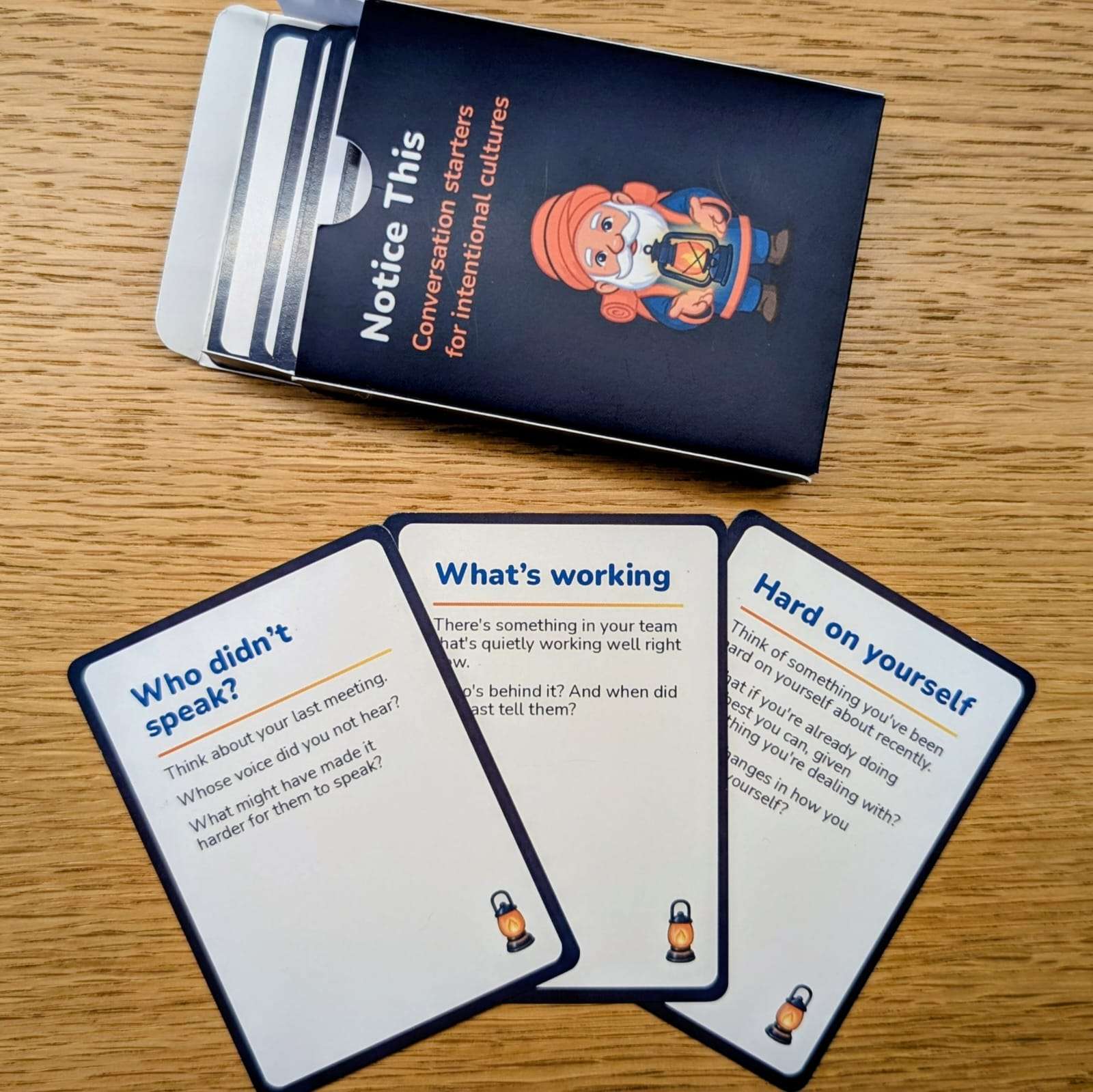
A few weeks ago, we launched our Hu.Be platform at the Engage Employee Summit in London. And to engage with people, we created this “conversation starters” card deck.
Davide Pagnotta · 13 July 2026 · 3 min read

In almost every workshop I run, I ask teams a simple question: “How do you make decisions?” The most common answer is: “We look for consensus.” It sounds mature. Collaborative. Healthy....
Davide Pagnotta · 12 February 2026 · 5 min read