This wish is familiar from my own life. Trying to manage other people’s view of me used to feel like my full-time job.
I thought my imprint on other people was the measure of who I was. I needed everyone to like me and approve of me. It was exhausting.
I devoted tremendous energy to upholding an image of myself, an outer shell like a decorated Easter egg. I thought I was laboring to please other people, but in fact, I was constructing a defense, a highly dysfunctional one.
And the fundamental flaw in it was that I over-identified with that shell. This is the error that Alice Miller describes (in The Drama of the Gifted Child) as the starting point of narcissism, and it leaves people feeling, of course, like a shell: brittle, fragile, and most of all, hollow.
We are not our outer shells. We are not the image that other people see.
But I didn’t understand that yet. When someone directed anger or judgment my way, I felt damaged. I felt as though the person could aim a laser of negative energy at me, and inflict pain even from many miles away.
When I felt hurt, people would tell me to be less sensitive, but I didn’t know how.
Photo by Aimee Vogelsang on Unsplash
If I could go back in time to give myself advice, I would say: look within. Shift your attention off your outer shell and put it onto your core.
What you pay attention to grows. You’ve been paying too much attention to your shell. Pay attention to your core self, and it will grow, too.
This isn’t easy or quick work. It takes diligent practice. It can be done in meditation, therapy, coaching, journaling, or creative work. Anything that helps you listen to your inner self.
As the ancient Greeks advised, “Know thyself.” The meaning of this simple injunction is infinitely deep. I would add, “Feel thyself.” Literally feel your own presence. It is much stronger, more constant and reliable than any shell of outer attributes. In fact, as you grow your awareness of your inner core, your need to maintain a shell falls away.
Now that I can feel my core self better, I can relate to people’s judgments and anger with more equanimity.
If someone attacks me, I can stand in my own two shoes and witness the other person struggling with their feelings, knowing that they are simply expressing themselves. I’m more able to see that everything they say is an expression of their mind frames, and I can decide freely what criticisms are useful for me to take in.
I don’t have to take their all-caps messages to heart; I can hit my inner unsubscribe button.
There’s an old tale that’s instructive for this practice. The Buddha was giving a speech when a young man confronted him, hurling angry invective in his face. The Buddha calmly asked the man, “If you offer me a gift, but I refuse to take it, to whom will it then belong?”
The angry man replied, “It will belong to me.”
And the Buddha explained, “Even so do I refuse the gift of your anger and insult. They belong to you.”
The young man realized that his anger was his own, and bowed to the Buddha in thanks for the lesson.
Think about the conflicts in your life, situations where you feel attacked or judged. Feel your feet on the ground, feel your own presence, and try viewing the attack as the person’s self-expression that belongs to them. It won’t land on you if you don’t receive it. The greatest martial arts master is the one who never receives the blow.
Why do obvious team problems go unaddressed? The usual fixes, from pulse surveys to away days and perks, soothe the symptoms without touching the cause. So what stops everybody from going beyond the surface?
I've just started a round of interviews to solve this mystery. If you're a team leader, senior manager, or executive and you'd like to be interviewed, send me a message. I'll share the outcome of the study with everyone who takes part.
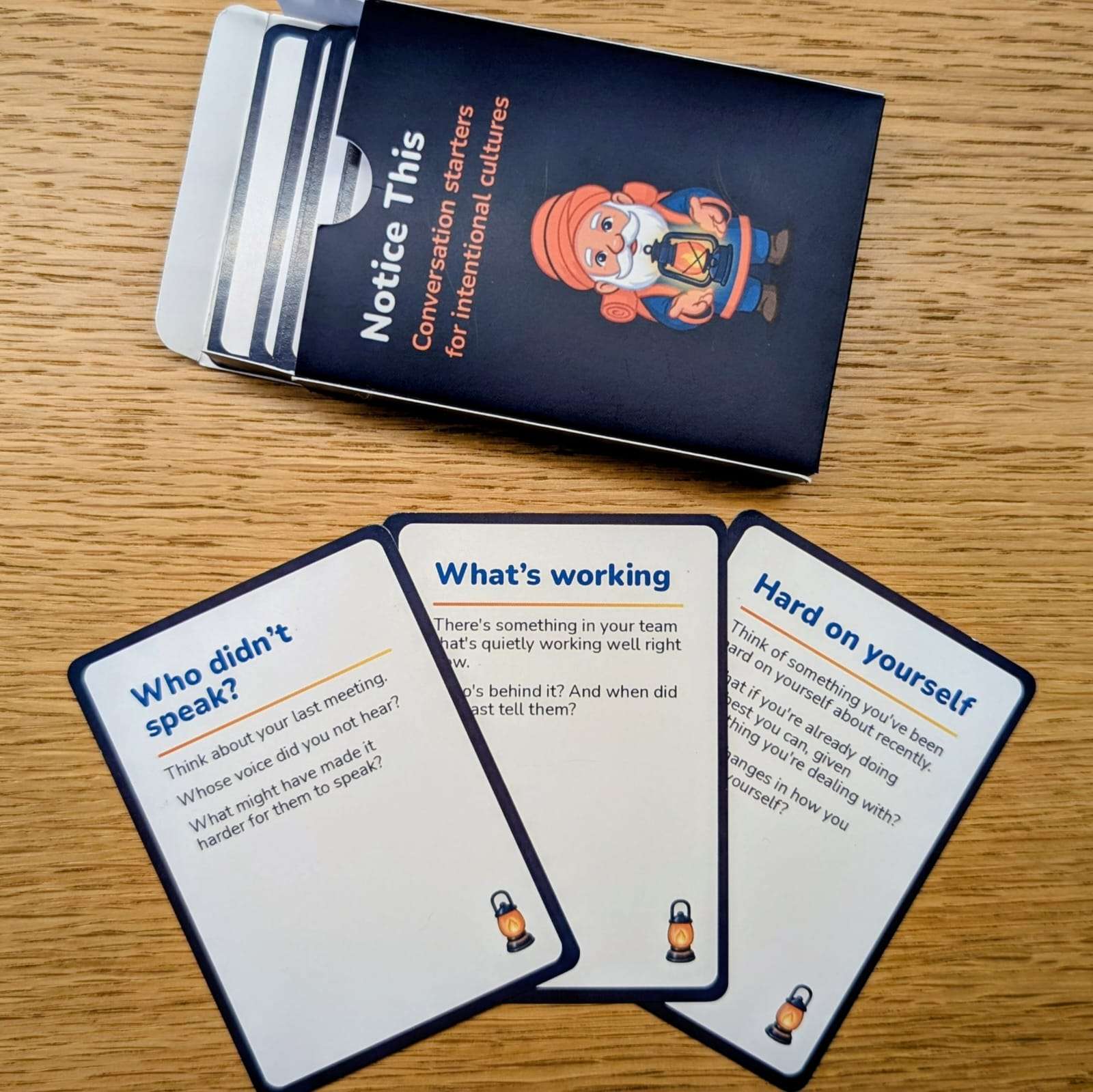
A few weeks ago, we launched our Hu.Be platform at the Engage Employee Summit in London. And to engage with people, we created this “conversation starters” card deck.