Someone recently apologised to me. I was glad to hear it, but I wasn’t entirely satisfied. What they’d done had a real impact on me, and while I was hearing “sorry”, I was still left alone to deal with the aftermath.
And yet, the moment they apologised, I felt embarrassed, with an urge to close the subject and change topic. As if it wasn’t my place to ask for anything more. I felt a pressure, from inside, to accept the apology and move on.
I don’t think I’m alone in this.
The pressure to move on
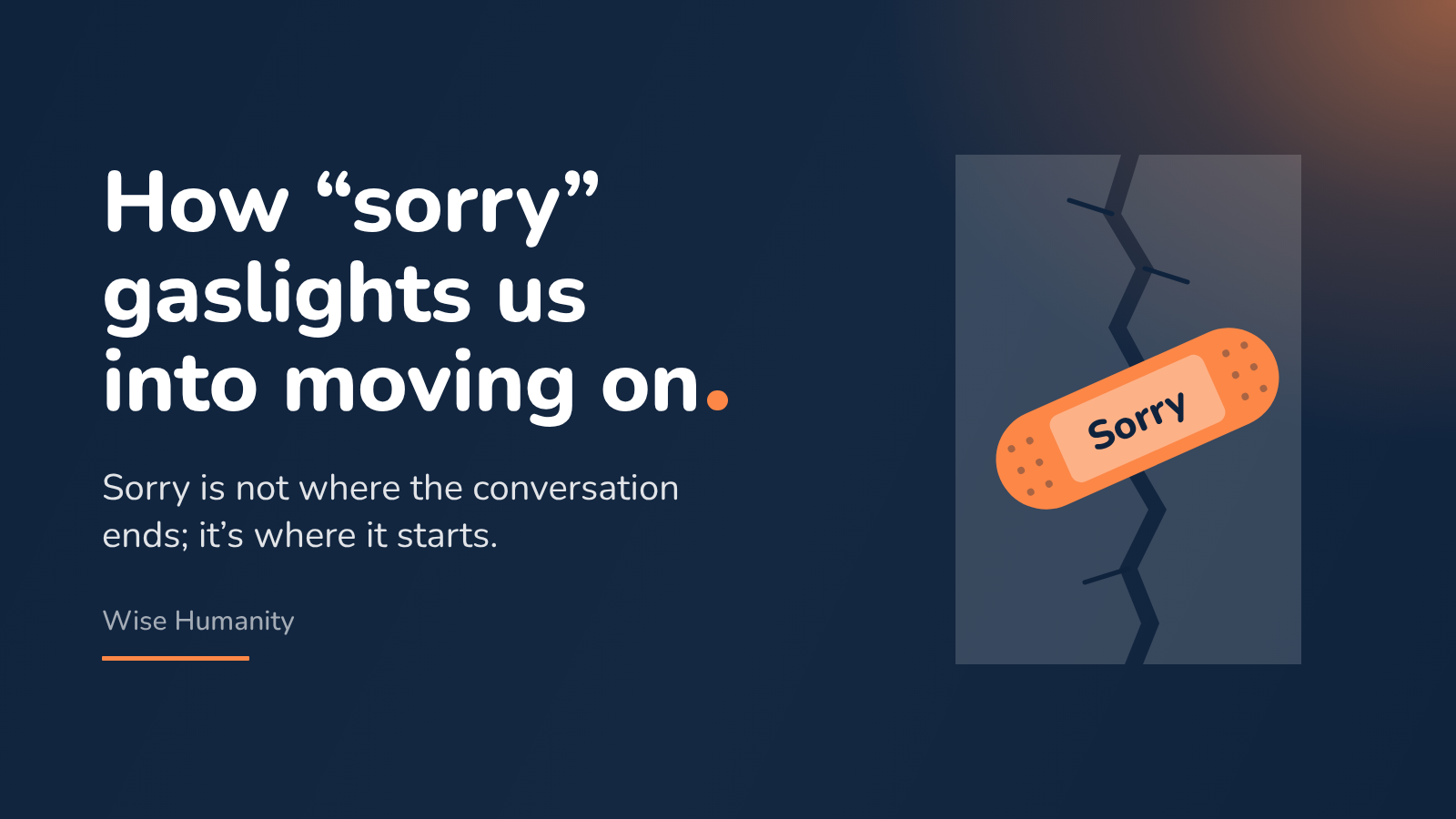
The moment someone says sorry, a clock starts ticking. There’s an unwritten rule: a sorry must be accepted, and quickly. Hold the line for more than a moment and we start doubting ourselves. Am I being unforgiving? Am I making too much of it? Am I the difficult one now?
That’s the gaslighting I mean. Nobody is doing it on purpose: not the person apologising, not the people around us. It’s a social and cultural expectation, so ingrained we rarely notice it, that makes us feel wrong for wanting more than words: a change, an action, some help with the damage. So we let it go, just to stop feeling like the bad guy.
It happens everywhere. A colleague who keeps missing deadlines. A partner who says sorry for reacting explosively (again). A friend who’s always late, always apologetic, and always late again (that’s soooooo me!). The apology sounds real. Most of the time, it is real. And the pattern stays exactly where it was.
An apology is a beginning, not an end
An apology tells us the other person sees that something went wrong. That matters. But seeing a mistake isn’t the same as changing what caused it, or helping to fix what it broke, even when the harm was unintended. Too often, we hear the sorry and act as if the change and the fix have already happened.
The discomfort we feel when something breaks is useful. It’s what creates the pressure for something to shift. When “sorry” dissolves it straight away, the pressure disappears before anything has changed. The pattern has no reason to break. And the damage is left for us to fix on our own.
The sorry that isn’t one
Some apologies make the gaslighting more literal. It happened to me not long ago. I was holding someone to an agreement we’d made, and the reply was: “I’m sorry you’re upset.”
Except I wasn’t upset. I was simply asking for what we’d agreed.
“I’m sorry you’re upset” sounds like an apology, but it moves the problem from the event to my reaction. If I accept the apology, I’ll end up wondering whether my reaction was the problem all along.
 Image courtesy of Keira Burton on Pexels
Holding the line is a form of care
Staying with the discomfort, rather than letting the sorry wipe it away, can feel unkind in the moment. It isn’t. It’s the clearest signal we can send that we take the other person seriously, and that we believe they can do things differently.
This is even more true for repeated “mistakes”. When we accept the same apology again and again, we unintentionally send a message: this is fine, it can happen again. We don’t mean it. But if the only consequence of a broken agreement is another sorry, there’s little reason for anything to be different next time. Good intentions rarely change a habit on their own. What changes it is something actually being different afterwards.
Three things to try next time someone says sorry
1. Treat the apology as the start of the conversation, not the end of a row. The useful question is not “are you really sorry?” but “what will be different now?” And the answer needs to be specific, not just a good intention.
2. Be consistent about what happens next. Not punishment, just reality. If a repeated pattern only ever leads to another conversation and another sorry, the apology stops meaning anything.
3. Trust your reaction. When you catch yourself thinking “maybe I’m overreacting” seconds after a sorry, pause. Ask yourself whether you’re being unreasonable, or just uncomfortable with holding the line.
These work at home as much as at work. With a partner, it might mean agreeing together on what you’ll both do differently next time things get hard. With a colleague, it might mean agreeing on a new check-in before the next deadline, rather than another apology after it.
Where the conversation really starts
None of this is about making anyone feel worse about a mistake. We all make them, and we all, well, many of us apologise. It’s about making sure a sorry leads somewhere.
Sorry isn’t where the conversation ends. It’s where it starts.