For Better Relationships, Rethink These Four Words
If I were you... for real. Even in our closest relationships, we often see each other from an outside view; we feel approval and disapproval, needs and demands. Frustration sets in when love doesn’t arise...
It’s a common phrase, often followed by well-intentioned advice. But let’s stop there in the middle of that sentence.
Usually, “If I were you” is understood to mean, “If I were myself, but in your position.”
But what an interesting thought experiment could follow those words.
If I were truly you…if I were born into your body, if I had grown up in your family, if I had had all of your formative experiences, how would I feel, and what would I do in your situation, facing your dilemma?
The answer is a tautology but worth saying: If I were you, I would feel exactly as you feel and I would do exactly what you are doing.
Because I would be you.
The thought experiment, at this level, moves us from the advice-giving role to a place of trust, respect, compassion and connection. At Wise Humanity, we call this approach to others “radical empathy.”
Empathy is the ability to sense and share other people’s feelings, allowing those feelings to resonate through us, and it’s a skill we can practice and develop. A closely related skill that can also be improved with practice is compassion, the desire for another person’s wellbeing, the wish to dispel their suffering and bring them joy. Compassion is at the heart of selfless love.
One fun way to develop greater empathy is to read novels; works of fiction invite us to imagine ourselves into someone else’s experiences.
An intense method practiced by Buddhist monks, who purposefully develop their compassion to the point that it shows in brain scans, is a traditional type of meditation called metta, or lovingkindness, sending loving thoughts, such as “May you be well. May you be happy. May you be filled with lovingkindness.”
Recently, I sat for a metta meditation toward my mother, and took a “radical empathy” approach to it, imagining what it would feel like to walk in her shoes. I reviewed her life, starting with scenes of her childhood familiar from pictures and stories, but this time I imagined seeing them through her eyes.
I mentally visited her childhood nursery, looked up to her parents, ate dinner with her nanny, hugged her blue teddy bear, and felt the little-girl feelings she has shared with me. I reimagined her escape at age seven from Nazi Germany, the long emigration by train and ship, the arrival in New York. As though they were my own memories, I traveled through the classroom scenes she has recounted, summer camp, concerts, romances, youth group trips and into adulthood, even through experiences we shared, but from her standpoint.
I imagined being her today, in her home, going through her day. Looking down at my hands to see her hands, sipping her tea the way she likes it.
And then I wished her well, as in a metta meditation, but from the inside, feeling the health and happiness that I wish for her, the upwelling of joy and love. I imagined her laughing with her friends, dancing in the kitchen, hugging her grandchildren, and peacefully enjoying nature, totally relaxed and at ease.
Even though I’ve always been close to my mom, this meditation took me to a new place of appreciation and connection. I felt a renewed wish for her happiness.
Radical empathy can be challenging if the person you’re thinking of is in great pain. You may not want to imagine yourself completely into that person’s experience, and you don’t need to. In fact, we can experience empathy fatigue by identifying too much with the suffering of others, as we see in the burnout rate among medical professionals.
But empathy is the gateway to compassion. And there is no such thing as compassion fatigue. On the contrary, compassion strengthens and uplifts us.
***********
So try a radical empathy and metta meditation for one person today. Give it ten minutes.
Think of someone you know and care about. Mentally put yourself inside that person. What does that person see? Go back in time, what did that person see, hear, and feel as a child? What were their experiences? Feel them as if they are happening to you. Go through the person’s whole life that way, as far as you know it.
Again, be INSIDE the person. Look out at the world through their eyes. Where are they today? What is happening for them? Feel their feelings as best you can. Give this experience your full attention.
When we look at the world through our own eyes, we automatically see the world revolving around ourselves. It’s a physical reality; if we turn in a circle, the world turns around with us at the center. Now make this other person the center. Feel the reality of this person’s center.
Wish good things for this person and, in your imagining, bring those good things into their experience. Imagine the person experiencing health, joy, love and peace. Be the person as they receive gifts, achieve their goals, have wonderful experiences. The most important part is how they feel. Feel their joy as they laugh and hug, dance and sing, relax and breathe, love and feel loved.
Why do obvious team problems go unaddressed? The usual fixes, from pulse surveys to away days and perks, soothe the symptoms without touching the cause. So what stops everybody from going beyond the surface?
I've just started a round of interviews to solve this mystery. If you're a team leader, senior manager, or executive and you'd like to be interviewed, send me a message. I'll share the outcome of the study with everyone who takes part.
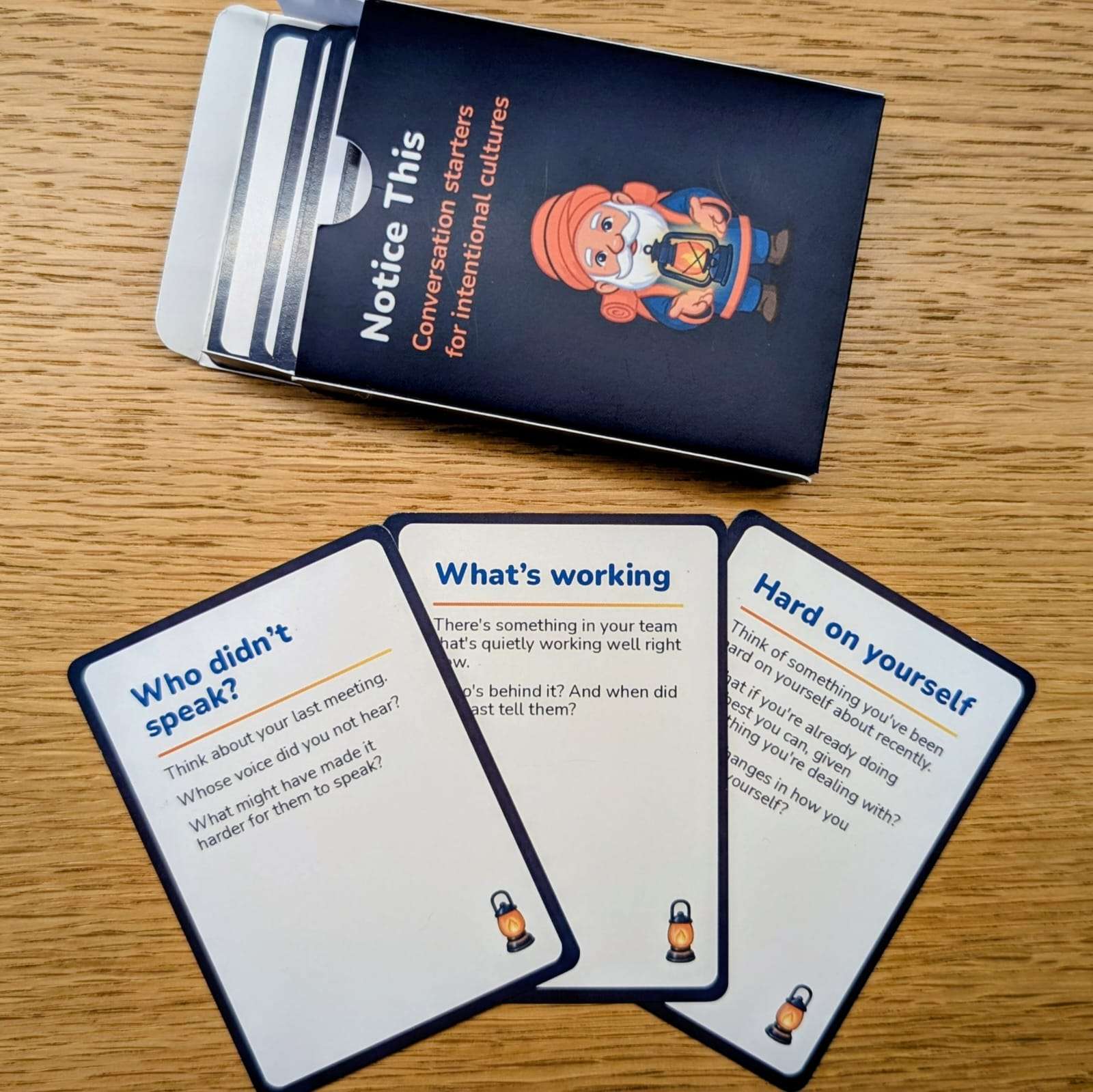
A few weeks ago, we launched our Hu.Be platform at the Engage Employee Summit in London. And to engage with people, we created this “conversation starters” card deck.