How a 15-person, 3-continent startup learned to trust, before they’d ever shaken hands.
The moment the COO hit “Send”
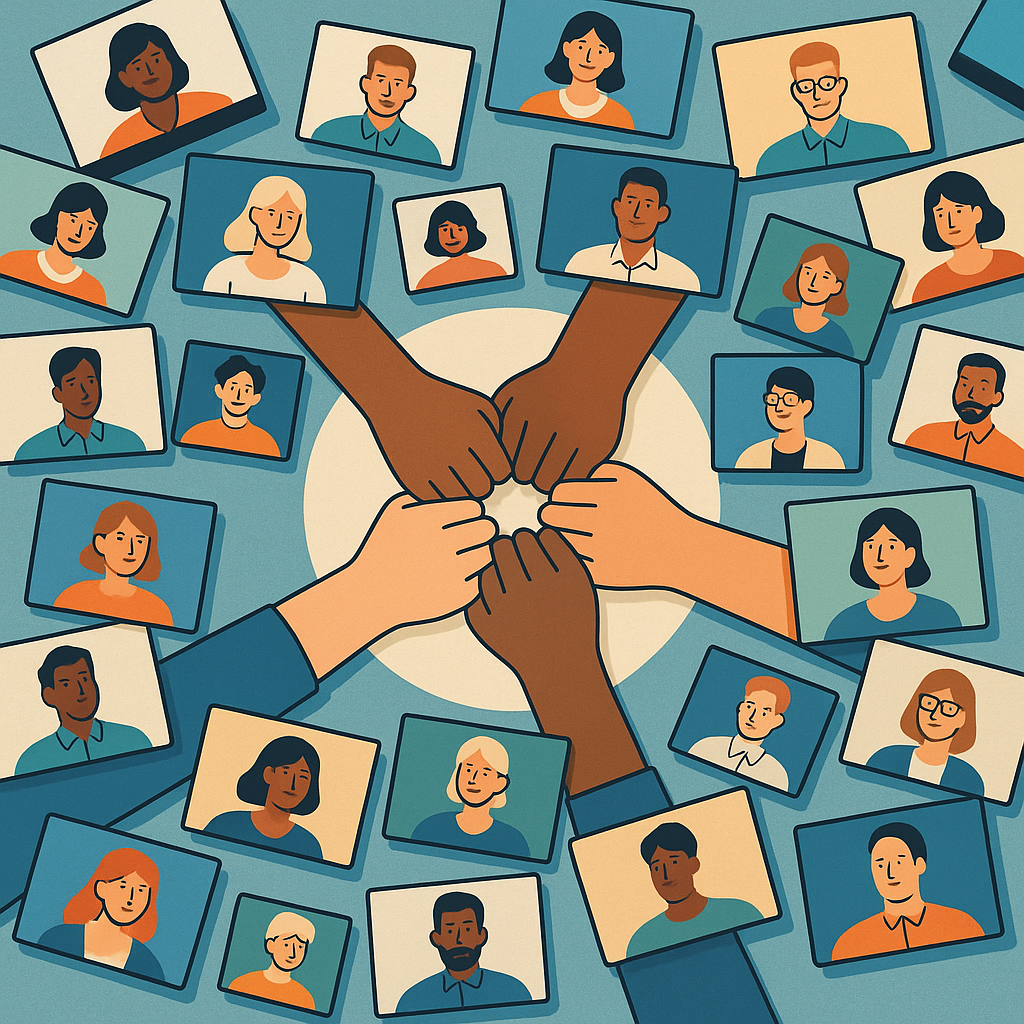
Picture a one-year-old startup dedicated to guiding people through their health journey. They were moving fast. In twelve hectic months, headcount had leapt from two founders to fifteen specialists scattered across the United States, Italy and Singapore.
It was exciting, and a little exhausting. People were proud of the work, but also stretched thin and, at times, alone behind their screens.
On paper, it was a dream team: data scientists, medical doctors, machine-learning engineers, ambitious business generalists. In reality, it was a group of good people working hard who barely knew each other beyond rectangles on a screen. Their success now hinged on something their code base couldn’t compile for them: human cohesion.
That insight struck the Chief Operating Officer during yet another “urgent” Slack thread that felt anything but urgent to her colleagues. She remembered a two-day workshop she’d once done with Wise Humanity and fired off an email: “Need help, yesterday.”
Underneath the urgency was a simple worry: Are we becoming a team, or just a set of smart individuals moving in parallel?
Why brilliant individuals can still sink a company
Every startup’s, every company’s, greatest leverage is its people. But the alchemy that turns high-performing individuals into a high-performing team rarely happens by accident, least of all in all-remote companies. Three friction points were stealing the founders’ sleep:
- Trust without proximity
Daily coffees and corridor chats never materialise when “the corridor” is a Google Meet link. With no shared language for feedback, people defaulted to polite silence, which the data team read as disinterest, while the clinicians mistook it for disapproval. The result: people felt careful, not candid.
- Conflict without body-language
Idea-rich disagreements are essential in frontier tech, yet nuance dissolves when half your sentence vanishes into packet loss. Arguments became binary (“my slide vs. yours”) instead of creative (“our third way”). Good ideas got lost because the tone, not the content, started to sting.
- Boldness without psychological safety
In health-care innovation, wrong turns are inevitable. But fear of public failure makes smart people hide half-built prototypes rather than risk showing unfinished work. Several teammates admitted they were carrying more stress than they let on.
Putting the Wise Humanity EQ Toolkit to Work
The COO asked us for something that would stick, not another feel-good workshop everyone forgets by Monday. We designed a 6-session custom Team Accelerator anchored on the Wise Humanity EQ Toolkit, a set of practical micro-skills for:
- Relational trust
- Constructive conflict
- Psychological safety rituals
We kept it simple on purpose: short sessions, real practice, and room to try again.
We met live on Zoom at times that worked for everyone; between sessions, people practised short, scripted conversations so the new habits stuck in day-to-day work.
The moment it clicked
Slack thread about a new strategic decision started stretching into screens of messages. The tone was getting sharp, the decision kept slipping, and you could feel the here-we-go-again feeling.
This time, someone said, “Quick huddle?” Ten minutes later, they were on a call. Each person shared what mattered most, they agreed on a small trial to test different strategic approaches, put a date on the calendar to review, and got back to work. The channel felt lighter within minutes.
No drama, no long meeting, just a steady, human reset.
People started saying it out loud. That shift didn’t go unnoticed:
“Wise Humanity created an incredibly safe space.” Engineer
“We are a better company now.” Co-Founder
And our favourite:
“It created a strong sense of belonging among all of us.”
So what actually changed?
Day to day, the team felt calmer and more connected.
- Faster decisions, project-triage meetings dropped from 90 minutes to 30 because people surfaced reservations early instead of late.
- Cross-discipline empathy, the “data folks vs. doctors” framing melted; each sprint began with a five-minute “role card” ritual so teammates could see the world through each other’s lenses.
- Client impact, with their own EQ muscles flexed, the team approached patient-data conversations more sensitively, earning unsolicited praise.
Numbers will follow (these things do show up in revenue and churn), but the qualitative shift was obvious: people laughed more on calls, argued earlier in the cycle, and volunteered stretch assignments instead of avoiding them.
Try this tomorrow: three micro-experiments for busy founders and execs
Tiny, human practices you can run tomorrow.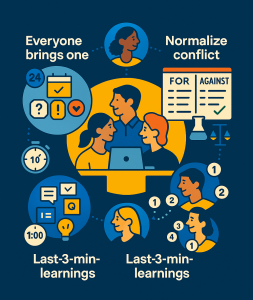
-
Relational trust, “Everyone brings one”
24 hours ahead of your next meeting, ask every person to add one agenda item to a shared doc (it can be tiny: a question, a blocker, a quick update, or a thank-you). In the meeting, start with those items, one minute each.
Why it helps: Everyone gets airtime and feels heard; you surface small needs before they become big frustrations.
-
Constructive conflict, “Normalize conflict”
At the next high-stakes decision, everyone brings one strong FOR and one AGAINST. In the meeting, do a fast round of FOR (one sentence each), then AGAINST. Capture points, pick the riskiest assumption, choose a small test or decide, set a review.
Why it helps: Balances voices, surfaces risks, avoids groupthink.
-
Psychological safety, “Last-3-minutes learnings”
Round-robin at the end of any meeting: “One thing I learned or would do differently next time is…” Leaders go first; keep it to one sentence each.
Why it helps: Normalises sharing imperfect work; people feel safer raising issues earlier.
Why this matters beyond one startup
Remote or hybrid work is how we operate globally. Ignore the relationships that hold your team together today, and you’ll pay for it tomorrow. The health-tech startup in this story avoided that fate by investing early in the human layer.
Your company may be entirely different, fin-tech, climate, consumer social, but the physics are the same. Cohesion transforms bright sparks into sustainable burn. Trust turns conflict into creativity. Psychological safety converts failures into IP. It’s about results, and about how it feels to achieve them together.
Ready to build a team that feels like a team?
If you’re determined to turn high-performing individuals into a truly cohesive unit, let’s talk. Tell us what you’re wrestling with, and we’ll meet you there.
Drop us a note and we’ll explore how Wise Humanity can accelerate the people side of your growth curve, before the time-zones, silos and “urgent but not urgent” Slack threads take their toll.