I’m excited to start the Wise Humanity blog adventure with this story. It’s an old Sufi tale I first heard back in 2009 from Professor Rao, with whom I’ve been working in close partnership since 2017 and on whose teachings Wise Humanity itself was founded.
What doors open when we stop labelling what happens to us?
*****
Some of you, at least intellectually, may be familiar with the concept that events are not necessarily intrinsically good or bad, but that it often depends on the perspective we look at them from. (I’m obviously not referring to injuries or physical illnesses here.)
Think of a rose. We can say, “This rose is beautiful, but it has thorns,” which gives it a negative spin, or we can say, “Despite the thorns, this rose is beautiful,” which gives it a positive spin. Subsequently, it’s a fact, this rose has thorns, but our attitude and even our emotions towards it change a great deal, and actually go opposite ways, depending on how we decide to look at it.
So, it’s almost common knowledge that the way we tackle a situation doesn’t depend on the situation itself, but on how we look at it.
Good or bad are in the eye of the beholder.
This is useful, but equally flimsy advice as it still leaves us trapped in the duality of good vs bad. My mood, energy level or any other external situation can easily cause my attitude towards a problem to swing from positive to negative. I’m sure many of you have experienced that.
The good-bad duality is so profoundly ingrained in our culture that we actually think the two things go together and you can’t have one without the other. In fact, we often say, “There’s no rose without a thorn” to remind ourselves that there’s no good thing without a bad side to it. And, which is basically the same but from the opposite angle, we also say, “Every cloud has a silver lining” to remind ourselves that there’s always a bright side to an unpleasant situation.
Try focussing on the silver lining without noticing the black clouds.
Still… have you ever shared a problem with a friend who then told you, “Hey, come on, look at the bright side!” and have you ever reacted thinking, “Oh, yeah, sure”? It didn’t sound like the best advice at that moment, did it? It almost felt like they weren’t even listening and didn’t understand you.
The reason is that, even in the most optimistic cases, when something bad has happened to us and we tell ourselves to focus on the bright side, we’re unconsciously telling ourselves that yes, there is a dark side too, but we need to ignore it.
Now, I don’t know about you, but when someone tells me to ignore something, I think of it immediately. If I ask you not to think of a pink elephant, what are you thinking about right now?
Stop thinking of the pink elephant now.
It’s no wonder then that telling someone, or even ourselves, to look at the bright side doesn’t always work or only works temporarily. The next time something bad or unpleasant happens to us, we’re back to square one, needing to look for that silver lining, having to force ourselves to ignore the big black cloud and the thorns of the rose.
Ultimately, the point is,
As long as we inhabit a story of good vs bad, we’ll keep bouncing in between them.
But how can we abandon the good-bad duality altogether? Well, here’s a more empowering tool, based on millennia of personal introspection as well as modern neuroscience.
This is the simple yet powerful concept it’s based on: Have you ever noticed that when something undesirable happens to us, we start suffering from it not when it happens but when we label it bad?
Let me repeat it:
When something unwelcome happens to us, we start suffering not the moment it happens but when we attach the “bad” label to it.
And the reason is that the badness, the unpleasantness, the undesirability, is in our head. It’s not in the event. Events are just things that happen, mostly outside our control; the badness is in the label. The suffering is in the label and we are the ones who decide to stick that label onto it.
Before we look at some real-life examples, let me explain this concept with the famous Sufi tale I mentioned at the start. There are many versions of this story, here I’m using the one I heard from Dr Rao, which I’m particularly fond of.
*****
Once upon a time, an old farmer lived in a valley with his son, a handsome and dutiful youth. They lived a peaceful life despite a lack of material possessions. They were very happy.
One day, the old man borrowed money from the neighbours to buy a young and beautiful horse. The very same day he bought it, there was a huge storm. The frightened horse jumped the fence and escaped into the hills. The neighbours came to express their concern, "Oh, that's too bad. How are you going to work the fields now? And how are you going to repay us?"
The farmer shrugged his shoulders and replied, "Good thing? Bad thing? Who knows?"
A few days, while walking in the forest to gather new ideas, he bumped into his horse that was peacefully grazing the grass together with another eight fine horses. The farmer took them all, brought them back to the stable and built a taller fence so that the horses couldn’t escape. The neighbours again gathered around, "Oh, how lucky! We thought you were destitute, but look at you now, you can do much more work than ever before!" they said.
The farmer shrugged his shoulders and replied, "Good thing? Bad thing? Who knows?"
The next day, the farmer's son fell off one of the new horses and broke his leg. "Such misfortune," said the neighbours. The leg healed crookedly and left the son with a permanent limp. The neighbours were concerned again, "Now that he is incapacitated, he can't help you around, and he’ll never find a fine wife. That's too bad."
The farmer shrugged his shoulders and replied, "Good thing? Bad thing? Who knows?"
Soon, the news came that war had broken out, and all the young men were required to join the army. The villagers were sad because they knew that many of the young men would not come back. The farmer's son could not be drafted because of his broken leg. So the neighbours gathered around again: "How lucky! You get to keep your only son!"
The farmer shrugged his shoulders and replied, "Good thing? Bad thing? Who knows?"
And the story goes on forever.
*****
How many times in your life has something bad happened that then turned into a blessing in disguise?
“I lost my job,” and I immediately started panicking, looking for new job interviews with anxiety, feeling inadequate, imagining mental scenarios where all my family and friends leave me and I live in poverty and loneliness, spiralling into “I’m not good enough” self-deprecation. But then, three months later, I found an amazing job, in a great company where I feel much happier.
“My partner left me.” And, while it’s absolutely ok to feel sad for the end of a relationship where we had invested time, hope, feelings and dreams, many of us then start telling ourselves things like “Nobody wants me,” “I’m never capable of keeping a partner,” “When will I ever learn?” etc., and we spiral into loneliness or even depression. But then, a few months later, we find a better partner or perhaps we’re happily single and absolutely happier now that the relationship has ended.
Exercise
Now, stop for a few minutes and reflect on your past.
Can you think of similar examples where something happened that you immediately labelled bad, but then it triggered a chain of events that actually brought you something much better and you’re much happier than before?
Write down a few examples from your personal experience and memories. To help you do this, imagine you are telling the bad event to a friend.
Why did you label it bad? (e.g., what fears did you have? What future were you envisioning?)
How did you suffer? (e.g., feeling anxious about the future, feeling helpless, not good enough, etc.)
What happened next that changed the situation?
How do you feel about those events today when you think back?
Now, when you look back, can you realise that all that suffering that you brought upon yourself was unnecessary? Do you also realise that it started the moment you labelled the event bad?
Consequently the question is, since we don’t know what will happen in the future, why do we rush to label events bad and bring suffering upon ourselves? I’ll repeat it:
Why do we rush to bring suffering upon ourselves?
*****
Finally, here’s the tool that I would like to leave with you (based on the exercise above).
Events are events. They’re neither good nor bad.
They’re just events. Don’t label them.
When something desirable happens, by all means celebrate it.
When something undesirable happens, then, can you think of at least one chain of events triggered by that undesirable occurrence that will eventually bring much bigger happiness to you?
And also, can you think of one action that you can do to start moving in that direction?
Then don’t label what has just happened to you, don’t start your own suffering. There’s no need. You’re bringing it upon yourself by yourself. Just acknowledge that the event has happened, visualise the potential chain of events, and go take that one step, that one action in that direction.
What doors open when you stop labelling what happens to you?
Try using this template to apply this tool in your life and experience its power:
Think of an undesirable event that has just happened in your life.
Think of a feasible chain of events that could potentially take you out of the current situation and into a more favourable one (it may or may not happen, but the important bit is: can you think of at least one such feasible chain of events?)
What is one action you can take to set that potential chain of events in motion?
Now go and take that one action.
Over time, you can condition yourself to label events in a knee-jerk way. You can respond by saying to yourself with a smile, “Good thing? Bad thing? Who knows?” and freely choosing your next steps.
Why do obvious team problems go unaddressed? The usual fixes, from pulse surveys to away days and perks, soothe the symptoms without touching the cause. So what stops everybody from going beyond the surface?
I've just started a round of interviews to solve this mystery. If you're a team leader, senior manager, or executive and you'd like to be interviewed, send me a message. I'll share the outcome of the study with everyone who takes part.
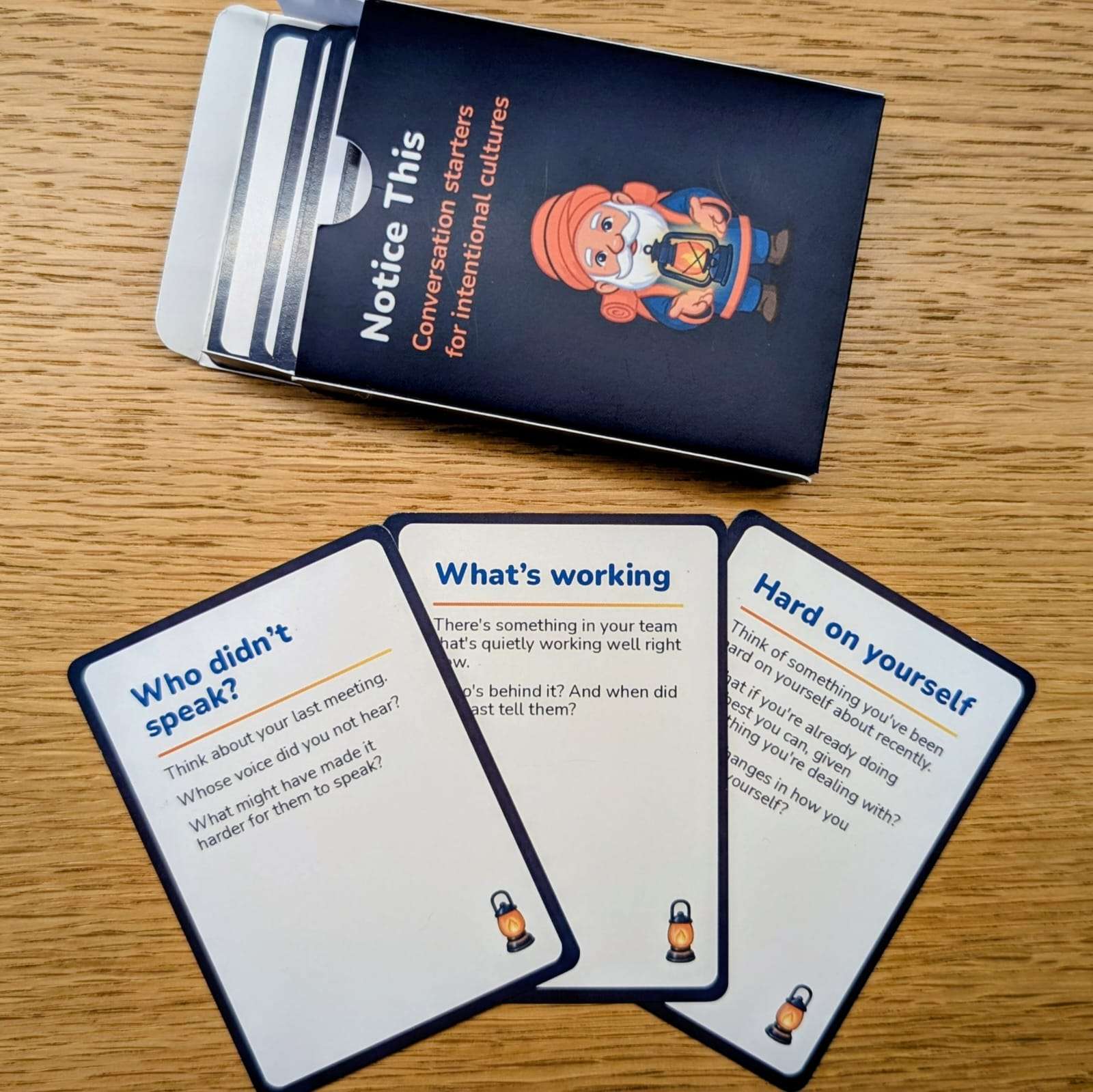
A few weeks ago, we launched our Hu.Be platform at the Engage Employee Summit in London. And to engage with people, we created this “conversation starters” card deck.