Now, a certain level of self-doubt can be a great companion: it shows us that there’s always so much more to learn. It can also help lead us to gather more people and resources to help in towards our goals.
However, self-doubt can grow into a haunting beast that paralyses us. Not only does it throw in our face all the areas of our personal or technical capabilities where we feel inadequate, it can actually make us feel not good enough for anything: for our dreams, our job, our partner, or even the next task in our to-do list. Just not enough.
Photo by Darius Bashar on Unsplash
The topic obviously came up at our course. One of our students even coined the term not-enough-ism.
The good news is that, if you find yourself stuck in the story of not being enough, there are various ways out of it.
*****
Here’s one that I find inspiring, if a tad radical.
Let's ask ourselves the opposite question: How will I know that I've been enough? By achieving a certain objective? By making a big enough contribution to a big goal? If that's the case, then I'm deceiving myself.
First of all, feeling enough because I’ve accomplished something leaves me vulnerable to not feeling enough whenever I fail.
But also, can I really take personal, individual credit for the contributions I make towards the objective I’m trying to achieve?
Say I’m an entrepreneur who’s growing a business, or a Marketing Director who’s stirring a new company strategy. I may as well succeed in my goals, but what about all the people who enabled me? Notice here that I’m not referring to my co-workers who contributed to the same goal. I’m referring to those who enabled my contribution: all the people who educated me; those who advised me; those who inspired me, whether intentionally or randomly; etc. The list goes on forever.
Incidentally,
there's no individual achievement, ever.
If we think we've achieved something by ourselves, we are delusional.
It’s great to realise I’m growing my business or making more customers happy: it’s a fantastic, fulfilling feeling. May I rejoice and be energised by it. However, if I define myself by this success and inflate my ego, I’m deceiving myself.
Photo by krakenimages on Unsplash
The point I'm trying to make is that "being enough" is a delusional objective. Even when I’ve actually been enough (and I’ve achieved what I wanted to), I haven't really been enough: I've only played a part in a much bigger play enabled by the whole system I live in.
So, what is happening when I don’t feel enough is, I’m thinking that I’ll have to deliver the whole contribution by myself, unaided. I’m putting the whole burden upon myself in isolation. But it’s both an emotional and logical mistake because it’ll be the whole system I’m part of that will (or will not) deliver the contribution, not just me. So, when I think of “being enough” that way, I’ll never be enough.
*****
Another way out of not-enough-ism is to realise that I am always enough. I’m enough for anything I've been put in this world for. It's almost by definition. I can't not be enough for what I've been put in this world for. Please pause and re-read this sentence:
I can’t not be enough for what I’ve been put in this world for.
So, if I use higher, tougher standards to measure how good I am, it's not the task that I’m trying to achieve that is making me feel not enough, it's my arbitrary standards (those arbitrary standards often come from society or someone we’re trying to please, but this material for another blogpost).
From this perspective, I can actually let go of the concept of "being enough" altogether. I don't even need to tell myself that I am enough. I am just right. Right for what I was put in this world for. What I've been put in this world for is defined by who I am, so I can't not be right for it.
*****
Nobody is ever good enough (because it’s the system that makes things happen, not the individual in isolation) and nobody is ever not good enough (because you can’t not be enough for what you’ve been put in this world for).
Just drop good-enough-ism altogether.
It’s not serving you.
You can obviously continue on your personal growth journey because you’re driven by being the best version of yourself and by making your best impact in this world, but you'll do that from a place of self-expansion, not from a place of "lacking something in order to be enough".
Why do obvious team problems go unaddressed? The usual fixes, from pulse surveys to away days and perks, soothe the symptoms without touching the cause. So what stops everybody from going beyond the surface?
I've just started a round of interviews to solve this mystery. If you're a team leader, senior manager, or executive and you'd like to be interviewed, send me a message. I'll share the outcome of the study with everyone who takes part.
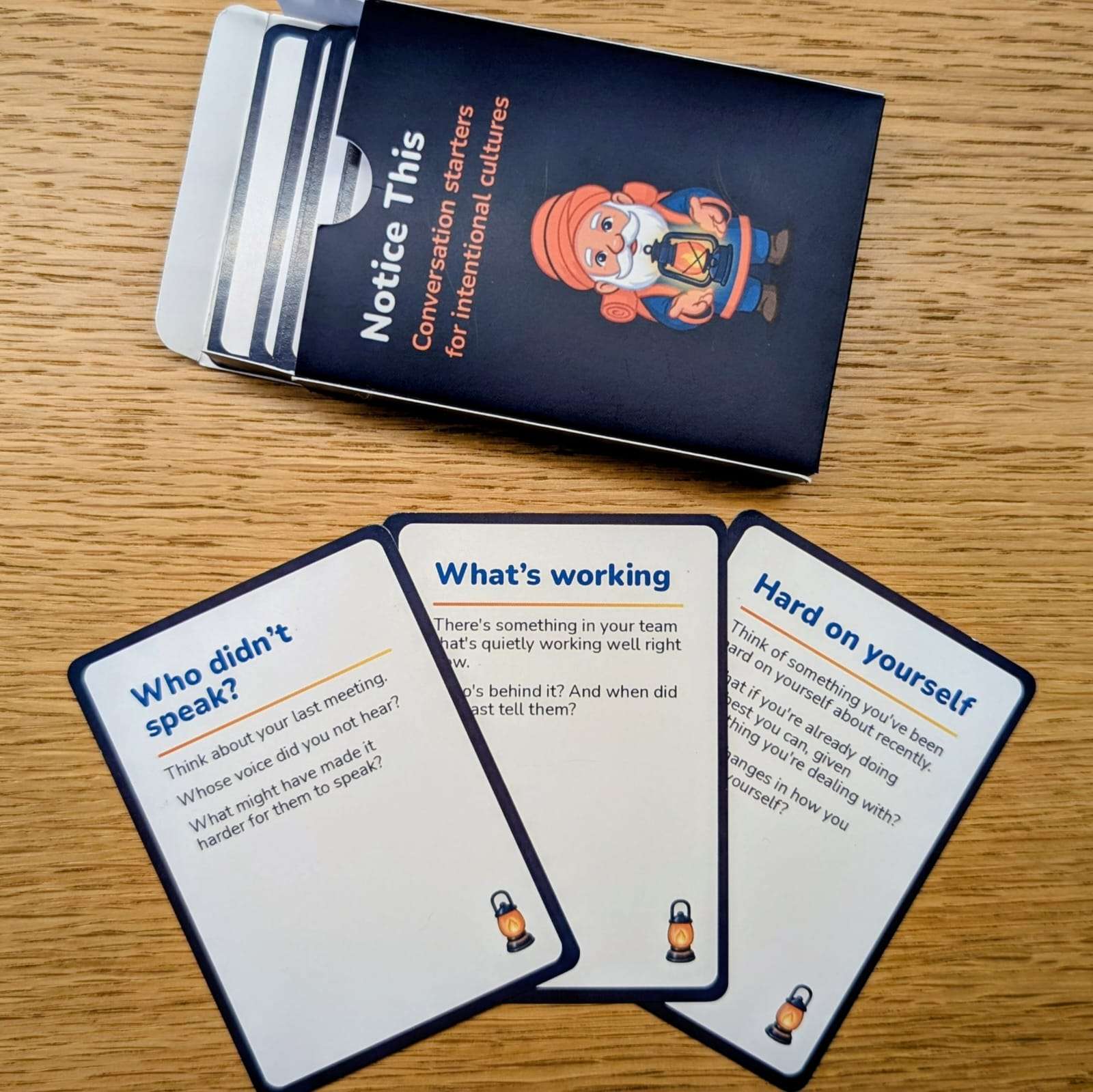
A few weeks ago, we launched our Hu.Be platform at the Engage Employee Summit in London. And to engage with people, we created this “conversation starters” card deck.