My Partner Doesn’t Make Me Happy. He Makes Me Grow
As I write this week’s blog, my partner is on a plane from Barcelona to London. One way ticket. He’s moving in with me. I haven’t lived with a boyfriend for almost nine years, and someone has now left his friends, his family, his job, and his country to come and live with me.
Fran (the boyfriend who’s on the plane from Barcelona) is one of the best Gestalt coaches I’ve ever met. One of the things we both profoundly believe in is that happiness is something you need to cultivate inside yourself, it’s not something you find in a partner, a job, a nice house or a cool holiday. Relationships are there to help us grow, not to complete us or even save us. (This is something I already wrote about in You Are not Defective. Our Model of Romance Is.)
If you build relationships where you look for growth, and this applies to any type of relationship, whether love, friend, family or work, you can build relationships that are actually much freer because they’re not burdened with the weight of the responsibility of making you happy.
You don’t expect your partner to be or do for you the things you can’t be or do yourself. You accept your partner for who they are.
Photo by Billy Pasco on Unsplash
Accepting someone for who they are doesn’t mean that they are necessarily right for you: it only means that you’ll stop mixing the relationship and its dynamics with your own projections, your fears, expectations, pain, anxiety and other possibly toxic patterns, and that you won’t let your partner draw you into theirs. Basically, it is the end of all co-dependency.
Accepting a partner for who they are also means you’ll be creating a place of love. This is not the exclusive romantic love of Hollywood movies. This is the true love that connects us with all living (and arguably non-living) beings; that connects us simply because we are human beings, and not because we please each other’s egos.
This place of true love is where we acknowledge and accept someone else’s angry outbursts with genuine empathy because we know they’re an expression of their pain. This is a place where we don’t need to defend ourselves because defending ourselves means that we let ourselves get drawn into our partner’s ego’s problems. If you want to see an example of this, watch the fighting scene from The Break-Up. It’s scaringly funny, and I’m sure many of us have found ourselves trapped in similar scenes.
From this place of true love, we share our thoughts and feelings without accusations or judgement. This place is the perfect place for transformation, both ours and that of our partner, where “relationship madness” turns into an opportunity for awareness and personal growth.
From such a place, there can also be separation, but it will be with love and gratitude for the journey made together. But when things do work, we move even more deeply into a journey of awareness together.
A typical argument for couples is jealousy. I’m sure many can relate to that: one accuses the other of some deplorable behaviour that “made” one jealous. It can quickly escalate to a battle without winners similar to the fighting scene above. It happened to Fran and me as well, particularly the first times we faced jealousy. Definitely not the best moments of our relationship. But we’ve learnt to tackle the problem from a different angle now: if I feel jealous, I don’t accuse Fran of lying or being disrespectful; I look inside myself to find the insecurities that created the jealousy. And then, I share them with Fran. And so does he.
In fact, a very healthy alternate mental map for romantic relationships is that
relationships are not there to make us happy but to make us conscious.
Think about it. Real, long-lasting happiness can be found only within ourselves. It can’t be external. Were it outside us, it wouldn’t be real and long-lasting but just delusional and impermanent like every external reality is. And it would turn us into slaves of whatever it is that we think is making us happy.
Relationships are there to make us conscious; they act as mirrors of our own pain and challenges, and as a workspace for our love and compassion.
And through this framework, they inspire us to grow and become a better version of ourselves.
This is a place of true love.
Photo by Tyler Nix on Unsplash
It takes a lot of courage to build relationships like that because you need to take complete ownership of the responsibility for your happiness, your problems and your personal growth. And you need to stop finding excuses or blaming the circumstances, your partner, your co-workers, your family and your friends for your unhappiness.
Where can you find that courage? It’s there inside you. Think of a situation in the past where you faced and overcame your fears. That time you had to speak in public? That time you had to apologise to a friend for your angry reaction? That time you told someone you loved and needed them? You’ve faced and overcome your insecurities and your fears before. You have the courage it takes.
My partner and I acknowledge our own insecurities and fears all the time. And we celebrate our courage.
Thank you for overcoming your fears, Fran. Thank you for leaving your friends, your family, your job, and your country to come and continue your journey of growth next to me. You’re a brave man.
Why do obvious team problems go unaddressed? The usual fixes, from pulse surveys to away days and perks, soothe the symptoms without touching the cause. So what stops everybody from going beyond the surface?
I've just started a round of interviews to solve this mystery. If you're a team leader, senior manager, or executive and you'd like to be interviewed, send me a message. I'll share the outcome of the study with everyone who takes part.
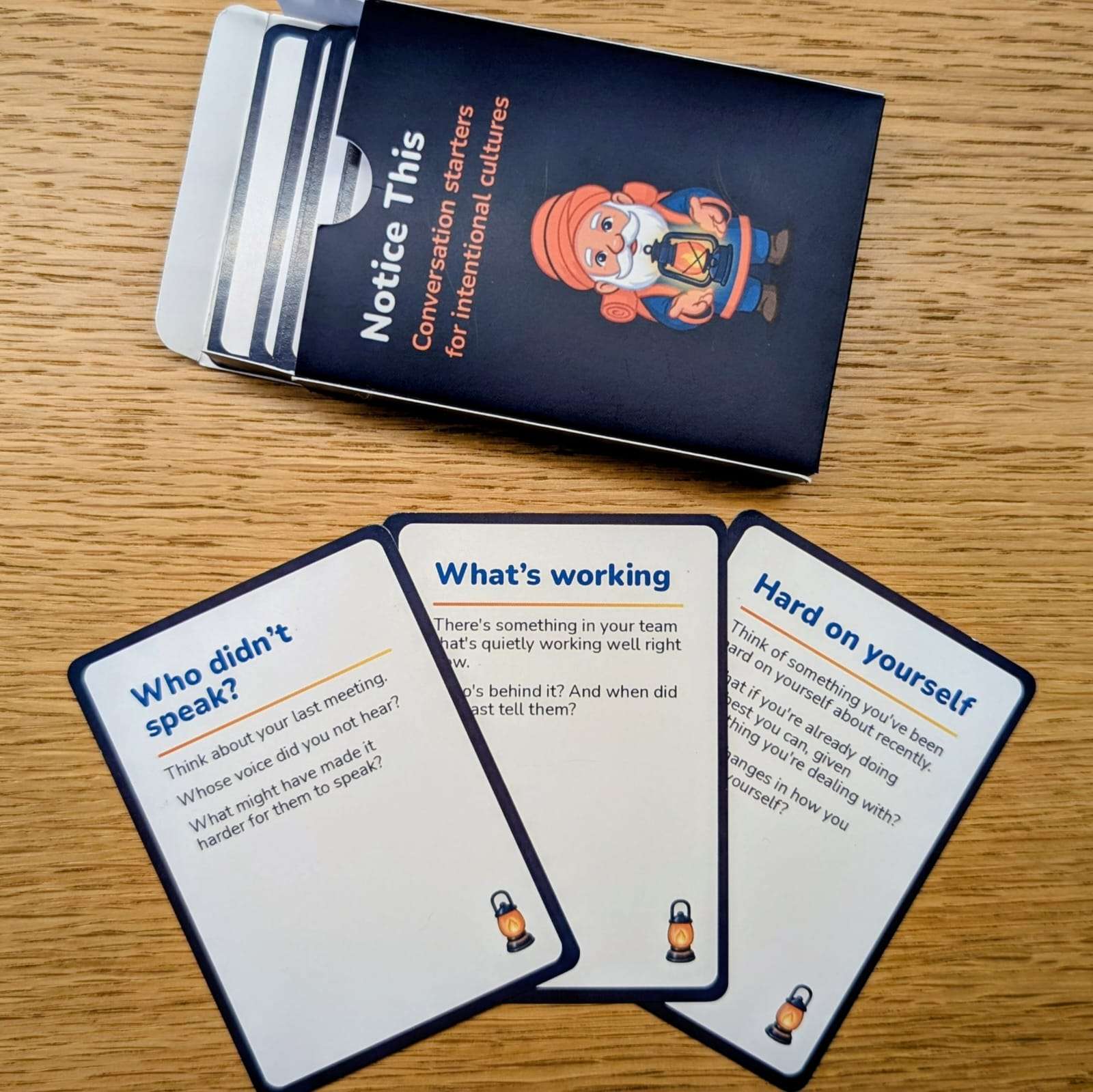
A few weeks ago, we launched our Hu.Be platform at the Engage Employee Summit in London. And to engage with people, we created this “conversation starters” card deck.