The tools we normally use to deal with ambiguity don’t really solve the uncertainty we find ourselves in; they mainly help us navigate it. But we can use a more radical approach and outgrow ambiguities altogether.
During my corporate years, I received loads of advice on ways to deal with uncertainty and ambiguity: manage your inner control freak; we simply can’t have all the information; be agile; be confident; learn stress reduction techniques; etc. It’s very good advice, but not always easy to put into practice because, in most cases, it directs us to withstand the stress but doesn’t address the core problem.
It was only when I deepened my personal growth journey that I learned a radically different way to look at ambiguities altogether.
Ambiguity is in our head.
Whenever we look to find an explanation for something, what we're doing is we're trying to fit a certain situation inside our (current) belief system. When we try to make sense of something, we're trying to adapt reality to our (current) mental frameworks.
Now, the attempt to make sense of what is happening around us is absolutely a fundamental one. The thing is, if we stumble into some ambiguity, we then try to find more answers to our questions, we look for more information, more data... That's also why ambiguities can paralyse us, because we feel we don't know enough.
Well, the thing is that we don't really need to find more answers. We need to find a new mental framework, based on which we'll ask different questions.
Now, how do we find this new framework, and how do we know that it’s working better?
Simply put, ambiguities normally consist of two opposites between which I feel stuck: good or bad, right or wrong, “Should I stay in my job even if it contradicts my values?”, “Should I be quiet at the next office meeting or speak up and risk upsetting someone?”, “Can I still be friends with my brother even if he has different political views?”, etc.
If I can find a mental framework that doesn’t use those two opposites, bingo! I’ll start asking different, less stuck questions or, even more simply,
the ambiguity will disappear altogether.
Here’s an example.
What's the right balance between work and life? I'm happy to challenge anyone to give me an answer that is actionable and unequivocal. The thing is, the separation between work and life is in our head. As long as we use mental frameworks that label certain moments as work and other moments as private life, we won't find a stable balance.
Now, we may not need to find a stable balance. We may be perfectly happy with that ambiguity and with how we're handling our life right now. But in case we're struggling with finding that balance, I would recommend exploring alternative mental maps that look at our life as something more holistic than two separate sections, one called wok and the other called private life. For instance, at our courses, we practice exercises based on connectedness, impact and purpose that help us look at our life holistically. The answers we find through those new frameworks are more empowering than arbitrary proportions between the time spent at the office and that spent with our families and friends.
Photo by Elena Mozhvilo on Unsplash
Here’s another example: the ambiguity of life and death.
This is a topic I often talk about with my partner, as he's afraid of death and struggles a lot with the uncertainty of not knowing what happens next, if there is something or nothing, what's the meaning of life, etc.
When we can't find adequate answers about life and death (and, again, I'm happy to challenge anyone to give unequivocal answers) and that search is keeping us awake at night (which is literally the case for my partner), we need to start looking for mental frameworks where the life-vs-death dichotomy doesn't exist. From there, we'll ask different questions... or, simply, the questions will have disappeared.
I wrote a blog about this topic (A vision of life and death that can bring you peace) where I explain my personal mental map about life and death. I'm not suggesting anyone who struggles with the life-vs-death ambiguity should buy into it. We all need to find the mental maps that best serve us individually. But I'm mentioning it here as an example of that we can find frameworks where dualities disappear for anything, even for life and death. Incidentally, my partner has found this one very useful.
So, whenever you feel stuck in some sort of ambiguity and paralysed by lack of information and answers, try dropping the questions altogether and start looking for alternative mental frameworks where the duality creating that ambiguity no longer exists.
The new space where you find yourself will be a very empowering one, presenting less uncertainty, more resources and more tools you can use to take new decisions and move on.
Photo by Casey Horner on Unsplash
And now join in the game
A couple of weeks ago, I was sharing these concepts with one of our students and we engaged in a bit of a game: she told me some of the ambiguities she’s dealing with in her life at the moment, and I had to suggest an alternate mental map where said ambiguities would disappear.
Here they are. And I’d really love you to join in the game. Send me your set of ambiguities, and let’s see what alternate, more powerful and empowering mental frameworks we can find where the ambiguities disappear.
Flow vs Effort
This ambiguity lies in the illusion of control. Only flow exists. The whole Universe (which includes you and me) is in a continuous state of flow. Effort is an illusion of our minds that we control things and that, if we put enough effort in something, we can achieve any outcome.
Body vs Mind
There's actually no distinction. Mind is made of flesh and its activities are neurons' interactions. Body is made of flesh and its activities are biological interactions. There's no difference between them: they're organic stuff having organic interactions. Both body and mind are things I can observe, therefore they’re not me. I'm the observer.
Complexity vs Simplicity
Both are just human labels. Nothing is complex and nothing is simple. Things just are. They are what they are. I label things complex when the mental frameworks I’m using to interpret them are not serving me well.
Incessant Questioning in Our Head vs Finding Answers
This is a potentially more complex one (don’t be alarmed if you find it hard to understand).
The questioning is actually not a question but IS the answer. It's our mind telling us what mental frameworks we’re using. Even the questions we ask ourselves through the voice in our head are actually answers to that same question, “What mental frameworks am I holding?”
REAL answers to REAL BIG questions are found by upgrading our mental maps, not by answering the incessant questions in our head.
I'd love to offer more alternative mental frameworks to solve more ambiguities. Please feel free to share them with me (privately or on our social media channels).
Why do obvious team problems go unaddressed? The usual fixes, from pulse surveys to away days and perks, soothe the symptoms without touching the cause. So what stops everybody from going beyond the surface?
I've just started a round of interviews to solve this mystery. If you're a team leader, senior manager, or executive and you'd like to be interviewed, send me a message. I'll share the outcome of the study with everyone who takes part.
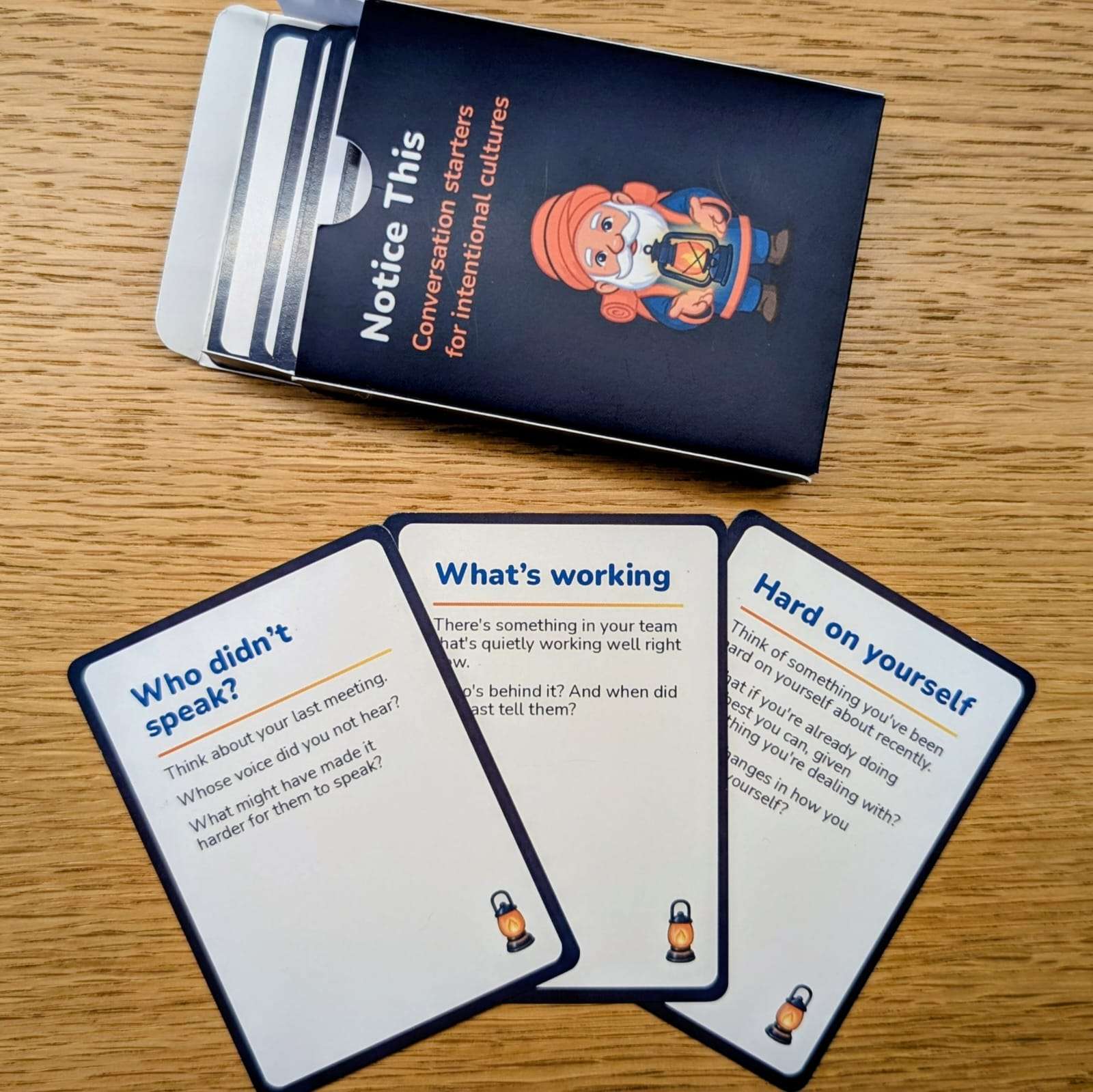
A few weeks ago, we launched our Hu.Be platform at the Engage Employee Summit in London. And to engage with people, we created this “conversation starters” card deck.