Summary
Quiet resistance (saying “yes” in the meeting and “maybe”, or even “no”, afterwards) slows execution and erodes trust. This blog explains why it happens and offers two simple rituals for sharper decisions and real buy-in that bring the team together and build exceptional momentum.
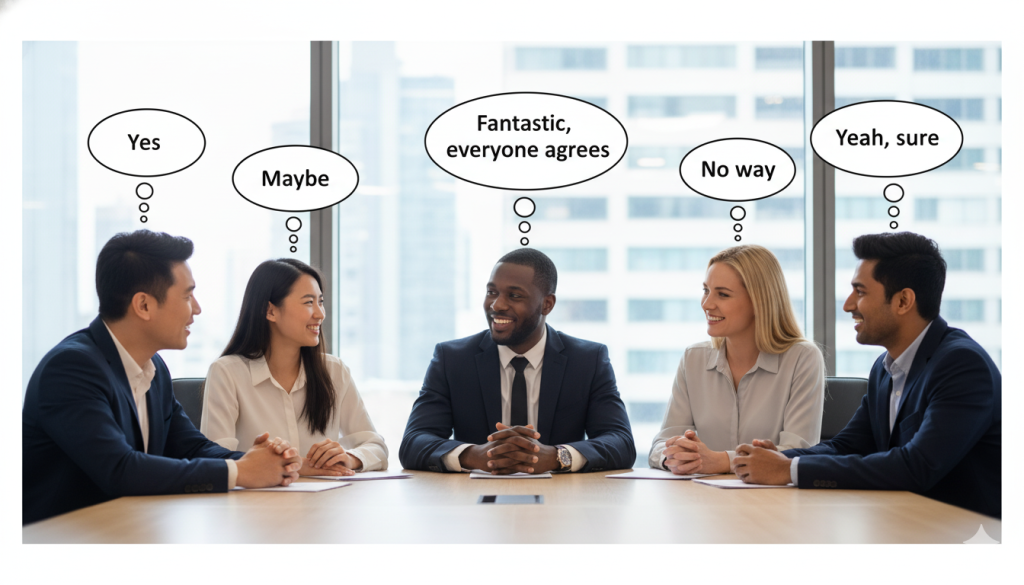
You’ve probably been in this meeting. Everyone nods. A decision is made, tasks are assigned, and a week later progress crawls. Emails stall, updates lag, and momentum fades. On paper, it looked like consensus. In practice, it was quiet resistance.
Quiet resistance is what happens when people appear to agree but don’t fully buy in. They say yes to avoid conflict, to protect relationships, or because it doesn’t feel safe to express doubts. It’s invisible at first, but it slows execution, drains trust, and quietly erodes performance.
Sometimes, the most expensive ‘no’ in your organization is the one that sounds like a yes.
Why this matters
Research and our field work show that quiet resistance can cost a team 15% to 25% of annual productivity. In a team with a $600,000 yearly budget, that’s $90,000, $150,000 lost, often without anyone realizing why. And this is a very conservative figure that doesn’t account for the business implications involved (e.g., losing clients, developing the wrong product, missing deadlines, etc.).
It isn’t necessarily bad intent. Sometimes teams are too polite. Sometimes trust isn’t deep enough for honest disagreement. Different causes, same outcome: delay, confusion, and “I told you so” moments that show up too late.
What’s really behind it
People don’t stay silent because they don’t care; they stay silent because the conditions around them promote that behavior. If the way we decide rewards speed over discussion, assertiveness over doubt, and agreeableness over dissent, then “yes” becomes the path of least resistance.
A simple shift leaders can make
This isn’t a people problem. It’s a system problem, and systems can be redesigned. Here’s an example of two small practices that we used with real teams in real life to turn quiet resistance into constructive challenge that strengthens the final decision and helps with everyone’s buy-in.
Imagine you’re at the end of a meeting where you’re making an important decision about a 3-month project. Everybody seems to agree on the plan.
1) Run a premortem
Before you finalize the decision, ask everyone: “Imagine we’re three months in and it turns out we failed. What went wrong?” This reframes dissent as risk awareness. Everyone gets to contribute and share their concerns, not just the loudest or bravest voices.
2) Add a guardrail metric
Turn the biggest risk from the premortem into a simple signal. If a key metric crosses a threshold, you meet again, review the plan, and adjust. This gives people confidence that their concerns were heard and built into the decision.
A real example
A team decided to focus the next 3-month marketing sprint on Professional Services firms. In the premortem, someone flagged a hidden risk: customer acquisition cost (CAC) might spike because Professional Services often require extra compliance and security reviews.
They turned that into a guardrail metric, and the team set a clear CAC threshold. If it crossed that line, they would pause, review, and adjust.
How powerful was that? You can run a CAC check after two weeks, you don’t need to wait for the end of the 3-month sprint.
What changes when you do this
- You have more insights that wouldn’t have surfaced otherwise.
- People say what they really think early, because the room invites it.
- Debate sticks to the idea, not the person, so decisions get sharper and faster.
- Ownership goes up. People don’t just agree; they feel listened to and they engage.
- You have an additional metric that fires a lot earlier than the success metric.
- ROI improves. Even a partial reduction in quiet resistance can feel like adding a team member without hiring.
How we help, Send us one frustration
At Wise Humanity, we use our EQ Toolkit to help teams spot invisible patterns like quiet resistance and swap them for healthier, more engaging and business-robust habits.
Send us one frustration your team is facing, and we’ll share two emotional-intelligence routines you can try right away, plus a quick ROI snapshot of what that friction is costing.
🏋️ Join our free workshops 🏋️
We run free 45-min workshops monthly where you can learn practical behaviours that tackle the most common team dynamic problems. Here are the next ones:
Because emotional intelligence is not intelligence if it’s not actionable.