Last week, I finally managed to go visit my parents in Italy after over a year. It was very emotional to see them in person and be able to hug them again.
Despite the long separation and the first-time presence of my partner, the old habits kicked in very quickly and my mum (whose pungent remarks have made her the star of my Facebook wall) soon started complaining about everything and everyone… You know, that’s what mums do.
Among other stories, she told us, in great detail, of a relative not greeting her during a family dinner and how she got offended and felt disrespected and hurt… to which my partner turned to me and said “I’m so like your mum.”
Reacting with disappointment, feeling upset and actually suffering when someone “disrespects” us is a fairly common, understandable attitude. Only a few days ago, I was talking with a coaching client who happens to feel disrespected and suffer personally a lot from a number of situations: her co-workers not doing what was agreed, or simply not doing a good job, or her husband not involving her in family matters, etc.
Now, while the actual event that makes us feel disrespected may be objectively annoying, the part that always strikes me most in such stories is how much the disrespected person suffers and holds on to that suffering. That is, my mum was really in pain, visibly hurt, while she was telling me the story of the disrespectful relative (an event that had happened months ago).
These situations always remind me of a quote attributed to different people, from the Buddha to Mandela:
Holding onto anger is like drinking poison and expecting the other person to die.
Feeling personally offended, which can last hours, days or even a lifetime in extreme cases, for someone else’s wrongdoing seems a lot like drinking that poison.
Now, the point is not that we should forget the wrongdoing and forgive the disrespectful person. Quite the contrary, I recommended to my mum that she should talk to that relative and I offered Fran and my coaching client a couple of alternative tools to handle similar situations in the future.
Photo by Hilde Demeester on Unsplash
The Cow
I like to refer to one of these tools as The Cow, after the explanation given by neuroscientist Wolf Singer, Emeritus Director of the Max Planck Institute for Brain Research, in his book Beyond the Self.
Even if we can’t have any direct experience of it, we can all intellectually accept that we don’t really know what’s going on in a cow’s mind and how she’s experiencing life, her brain being so different from ours.
Well, the thing is that, similarly, we really don’t know what’s happening in another human being’s mind, either, when they do something that offends us. The neuronal architecture of a person’s brain is uniquely designed by their previous experiences, their past history, their memories, the things they forgot and even by what happened when they were in the womb.
Bottom line, what is really going through someone else’s mind is as unknowable as what’s going through a cow’s mind.
Our relative might have been worrying about something big in his life when he didn’t greet my mum. My coaching client’s colleague might have been momentarily overwhelmed with work. Who knows?
The point is that, in most cases, we will never know, and reminding ourselves of the cow can help us handle potentially offensive situations with a lot less personal suffering. We don’t need to ignore them; we can still do something about them, but we can do it from a better emotional space, not from personal suffering.
Photo by Ben Weber on Unsplash
We’re all doing our best
Another alternative tool to getting offended is what Elisabeth, the other co-founder of Wise Humanity (who loves the cow a lot, by the way, it’s she who suggested I should add it to this blog), refers to as radical empathy (you can read more about it in Elisabeth’s blog For better Relationships, Rethink These Four Words).
The way I like to describe radical empathy is that, basically, everyone is doing their best, with the tools they have and their past history. Everybody is always using all their knowledge and experience in the best way they can.
If my mum had been in the disrespectful relative’s shoes at the family dinner, she wouldn’t have greeted herself either because, in that moment, she would have been in exactly the same situation as that relative, with the same worries and preoccupations, and with the same tools to handle them.
If I were in your shoes, I would do and behave exactly as you do… because I would be you… with your past, your experiences, your knowledge, your tools, your fears, your strengths and your weaknesses. I would be you fully.
Have you ever tried having a “difficult” conversation with a friend, a relative, a co-worker or even a stranger, armed with the awareness that everyone’s doing their best with the tools and experience they have?
It’s not about ignoring their potentially offensive, disrespectful wrongdoings, it’s about having those conversations from a much more constructive, connected, empathetic emotional state. The dynamics, and the outcomes, change completely.
Why do obvious team problems go unaddressed? The usual fixes, from pulse surveys to away days and perks, soothe the symptoms without touching the cause. So what stops everybody from going beyond the surface?
I've just started a round of interviews to solve this mystery. If you're a team leader, senior manager, or executive and you'd like to be interviewed, send me a message. I'll share the outcome of the study with everyone who takes part.
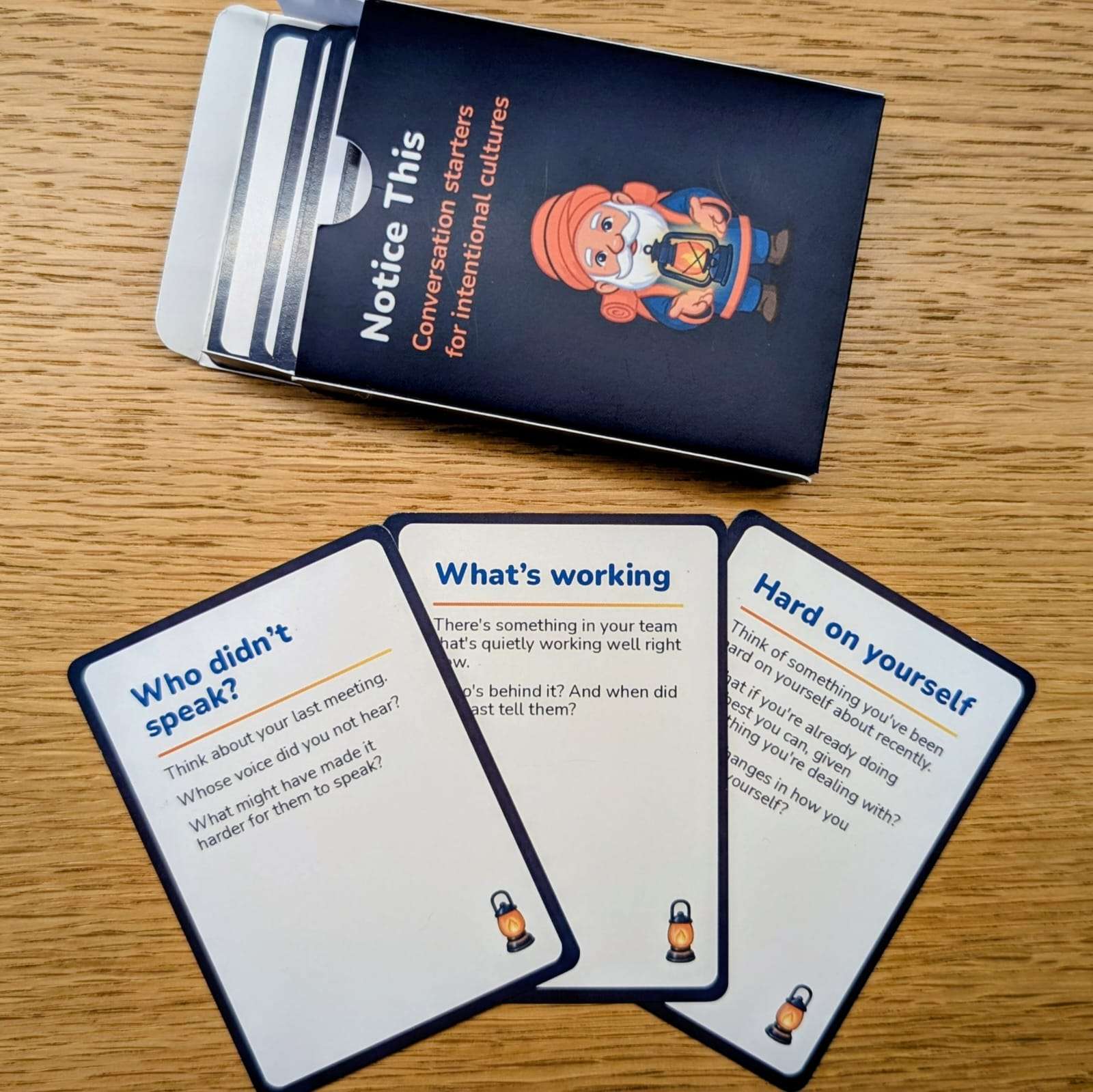
A few weeks ago, we launched our Hu.Be platform at the Engage Employee Summit in London. And to engage with people, we created this “conversation starters” card deck.