Much of the hustle and bustle of life has been cancelled because of the pandemic, so we should have more time in our days. We can live in our sweatpants, we don’t need to commute, and nightlife is reduced to Netflix and...
Recently, I’ve been talking with friends about how busy we feel.
We had hoped that the lockdown would offer a silver lining of peacefulness, perhaps a time to learn yoga, connect more with family, or write a book. We even hoped to strengthen ourselves on a deep level, and prepare for rebuilding the world in a better way after this is over.
Instead, many of us find the treadmill of life just sped up. Life has become more of a juggle than ever, and there seems to be no peace at all, just a more grim, monotonous grind. How is this possible? What is this really about?
We may attribute our busyness to new challenges that have arisen. Many of us are scrambling to earn a living in a gutted economy while supervising remote learning and caring for vulnerable seniors.
But consider this possibility: the feeling of busyness does not reside in our circumstances. The feeling is inside us, and we produce it ourselves.
Think about it.
You might feel like objecting: “This is not my imagination. I really have just sooo much that I absolutely have to do!”
Think about the people you really admire, great leaders and achievers. Most likely, they have (or had) a lot of responsibilities, too. Do you think of them feeling busy all the time? Complaining that they don’t have enough time in the day?
Here’s a snippet from my busy mind: I sit down for lunch. Oh, I haven’t taken my daily vitamin. On my way to get it. Hey, remember that email I was supposed to send this morning? Anxiety! I’ll remember to write it after lunch. Or should I put it on my to-do list immediately? No, I’ll remember it. I’m in the kitchen, what did I come here for? Oh yes, the vitamin. That reminds me that I canceled all my medical appointments when the pandemic began, I need to reschedule them. I'll mark it down on my to-do list. It’s an impossibly long list already! I can never get through all these tasks today. I bring my lunch to my desk and start typing. I hear three messages come in. I'll ignore them. No, I'm too curious. And now I need to answer, and I haven’t touched any of my main projects yet today. Guilt! I'm disappointing my team. I’m neglecting my friends. I need a break, I'll check a news site. Worry! I must to do some volunteer work for the election. There’s really nothing more important than that.
What have I done during this time? Eaten a few bites of lunch and answered some messages. Simple. Meanwhile, my mind is doing ten other things, cranking up my emotions so I feel busy, stressed and exhausted.
It’s the cacophony that I produce in my own mind that disturbs me. This is the internal state of busyness.
Now that home and work are in the same place, many of us are multitasking more than before. The problem is that our brains are not made to multitask. We can pay attention to only one thing a time. When we think we are paying attention to two things, our minds are actually just switching back and forth as fast as they can, and losing concentration with each switch. Anyone who has tried to have a breakfast conversation with someone reading the news can attest that multitasking just doesn’t work.
Some people have the illusion that they have a special gift for multitasking. But studies show that even for those people, multitasking hurts performance and efficiency, and lowers both intelligence and emotional awareness.
***********
Here is an experiment you can try, to mitigate busyness: stop multitasking for a week.
Do just one thing a time. When you wake up, focus on self-care before you turn to work. When you’re at your computer, quit all the programs you’re not using and turn off notifications. When you’re eating, just enjoy your food. When you’re exercising, just feel the energy in your body. When you’re with family, give them your undivided attention. When you’re on the phone, close your eyes and really listen.
Don’t be surprised if you feel massive resistance at first.
Multitasking is addictive, and your whole system may scream for that second and third task, that podcast to listen to while you’re folding the laundry, or that phone call to make while you’re driving and sipping coffee. Without multitasking, you may feel you’re wasting time, being less productive, or, heaven forbid, getting bored.
But what you’re really doing is allowing a little peace into your soul.
Your mind stops jumping around. Time slows down. Focus returns. Efficiency kicks in. You feel more yourself.
After a few days, you may even feel a lightness inside, as though you’ve been on vacation. You may notice more mental space, energy and openness, allowing you to dwell more in the areas of life that are truly meaningful to you.
Take a holiday from multi-tasking. Let your daily routine be like a visit to the beach, where you can let your attention rest on just one wave at a time. You will feel better for it, and chances are that the people you touch will catch some sunshine from you too.
Why do obvious team problems go unaddressed? The usual fixes, from pulse surveys to away days and perks, soothe the symptoms without touching the cause. So what stops everybody from going beyond the surface?
I've just started a round of interviews to solve this mystery. If you're a team leader, senior manager, or executive and you'd like to be interviewed, send me a message. I'll share the outcome of the study with everyone who takes part.
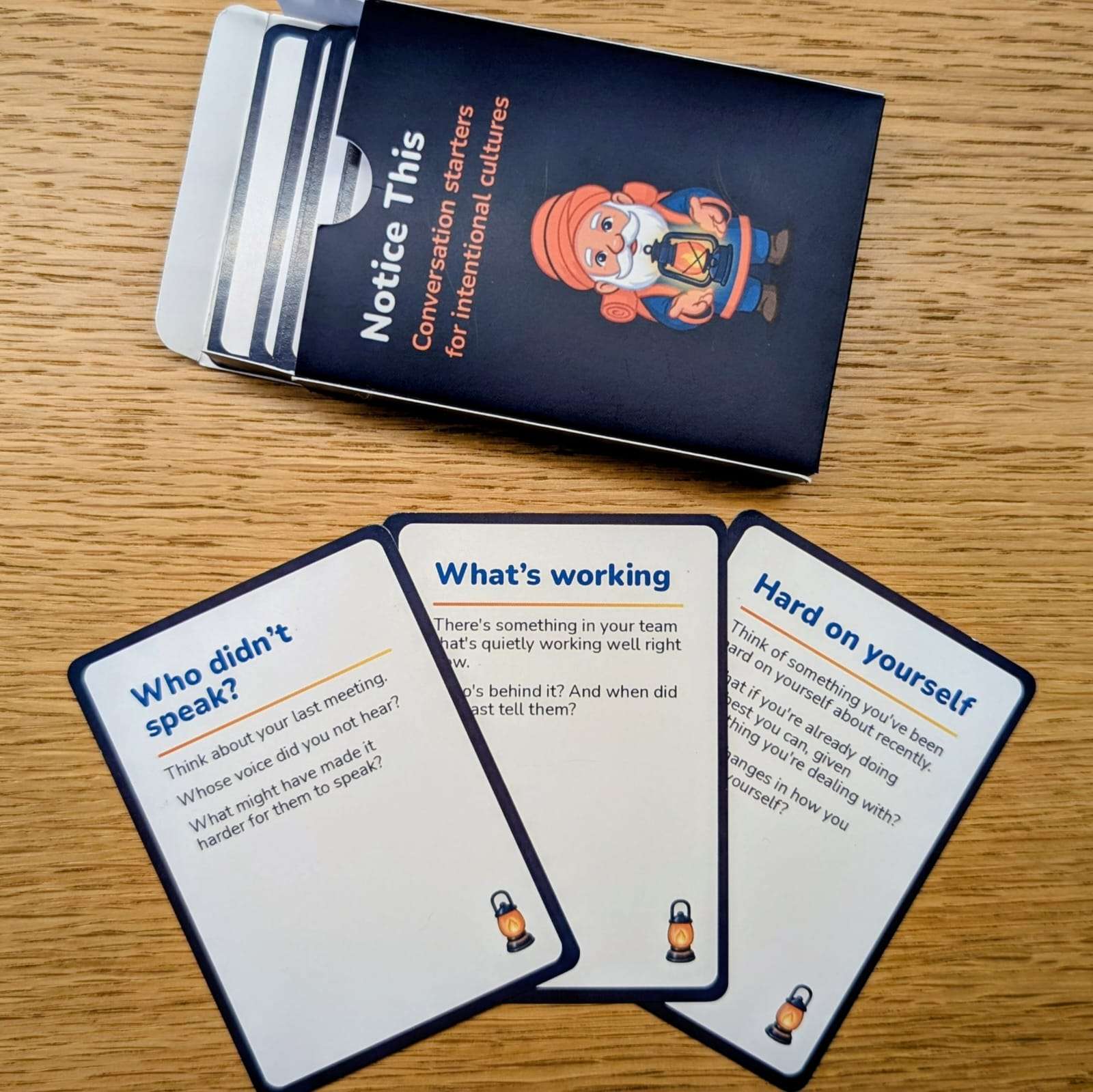
A few weeks ago, we launched our Hu.Be platform at the Engage Employee Summit in London. And to engage with people, we created this “conversation starters” card deck.