Have you ever felt that nobody will ever love you again? That you’re incapable of keeping a lover? That you’re not worthy of love and a happy relationship?
I’ve fallen asleep exhausted by my own crying. I’ve kept tens of friends on the phone for hours, for days, telling them the agony I was going through.
Photo by Trym Nilsen on Unsplash
The end of a love relationship hasn’t always been this bad (fortunately!!!) but, at different levels, for more or less time, it has often followed this pattern: it left me feeling that I wasn’t interesting enough, not sexy enough, not funny enough, not intelligent enough… that I wasn’t good enough for love.
Now, while suffering from the end of a love relationship, from losing someone we had been sharing so much with and making long term plans with is totally human, where did that feeling of not being a human being good enough for love come from?
A popular belief we’ve been brought up with is that we're halves that need to be completed.
In our language, we often refer to our partner as our “other half”, or even as our "better half," so not only do we need a partner to feel complete, but they're also better than us.
If this model of romance works for you, by all means keep it. Just keep in mind that, should it fail you in the future, you don't need to break down, you don't need to feel you're a failure in love and relationships, or even a failure in life. You just need to review the model.
I like to call it the Hollywood Romance Model (HRM): we’re not enough, we’re incomplete and need to find our better half to feel good, enough and complete. Oh, it can get even worse: we need to find someone who saves us.
By the way, while this is a very popular model, it’s historically very recent. Never in the past millennia has the HRM been the mainstream framework for relationships. In literature, romantic love was all about conquest, not about finding our better half. And when we got married, we’d get married for money, for power, for politics, for our parents' will, for convenience, to make children, to merge wealth, to stop family fights, to begin family fights, because we were young, because we were old, because we were healthy, because we were ill, etc., but never because we felt incomplete and needed to find our better half. Oh, and by the way, out of 7.7 billion human beings on this planet, there is only one better half, obviously.
Can you see the stress we bring upon ourselves and the burden we put on our relationships through the Hollywood Romance Model?
“I need to find the one that completes me.” And, “Now that I’ve found you, you need to make me feel complete, good and happy.”
Photo by Jeremy Jap on Unsplash
The first realisation is that the HRM is just a very recent framework. We all believe in it because we've been brought up in the Hollywood romance culture. That we need an intimate conversation with one specific person to feel complete, is just a belief produced by today's mainstream culture (and the diamond industry).
We are complete.
There's nothing incomplete about us. If we don't feel it, it's because we've added layers to ourselves that tell us we're incomplete. We need to find those layers, peel them off, like an onion, and drop them.
That’s personal growth! Not finding someone that will solve our problems and will save us.
Think about it. The damage we’re doing to ourselves is twofold: we’ve adopted a belief where our wholeness is outside of ourselves and we’ve created a framework for love where relationships are burdened with the task of completing and saving us.
While this may sound romantic (because we’ve been brought up to label it that way), it can break us down and put us on an endless, hopeless search for wholeness outside of us.
But we can find romance in so many other ways. At any point in time, we can always decide we want to merge our life with someone else's for multiple reasons: because we enjoy their presence; because being together with them opens new scenarios, new interesting paths to our journey (sharing parenthood, for example); or because, and this is extremely powerful, we feel that next to that person we're actually growing further, because they inspire us to be better people, and the relationship with them is a fantastic source of opportunities for further personal growth.
But not for a moment, while we decide we want to merge our life with someone else's, do we need to feel incomplete.
Why do obvious team problems go unaddressed? The usual fixes, from pulse surveys to away days and perks, soothe the symptoms without touching the cause. So what stops everybody from going beyond the surface?
I've just started a round of interviews to solve this mystery. If you're a team leader, senior manager, or executive and you'd like to be interviewed, send me a message. I'll share the outcome of the study with everyone who takes part.
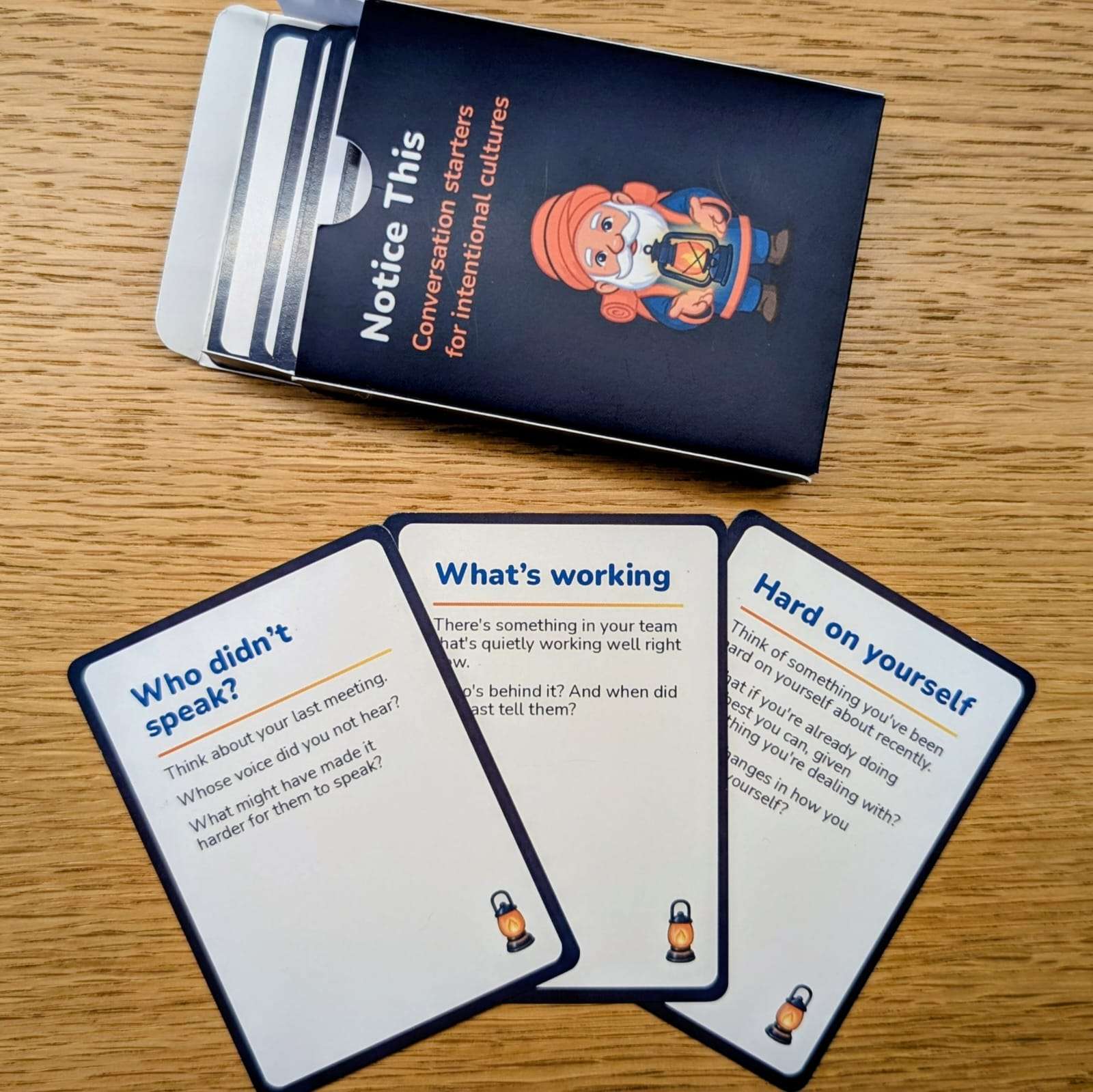
A few weeks ago, we launched our Hu.Be platform at the Engage Employee Summit in London. And to engage with people, we created this “conversation starters” card deck.